

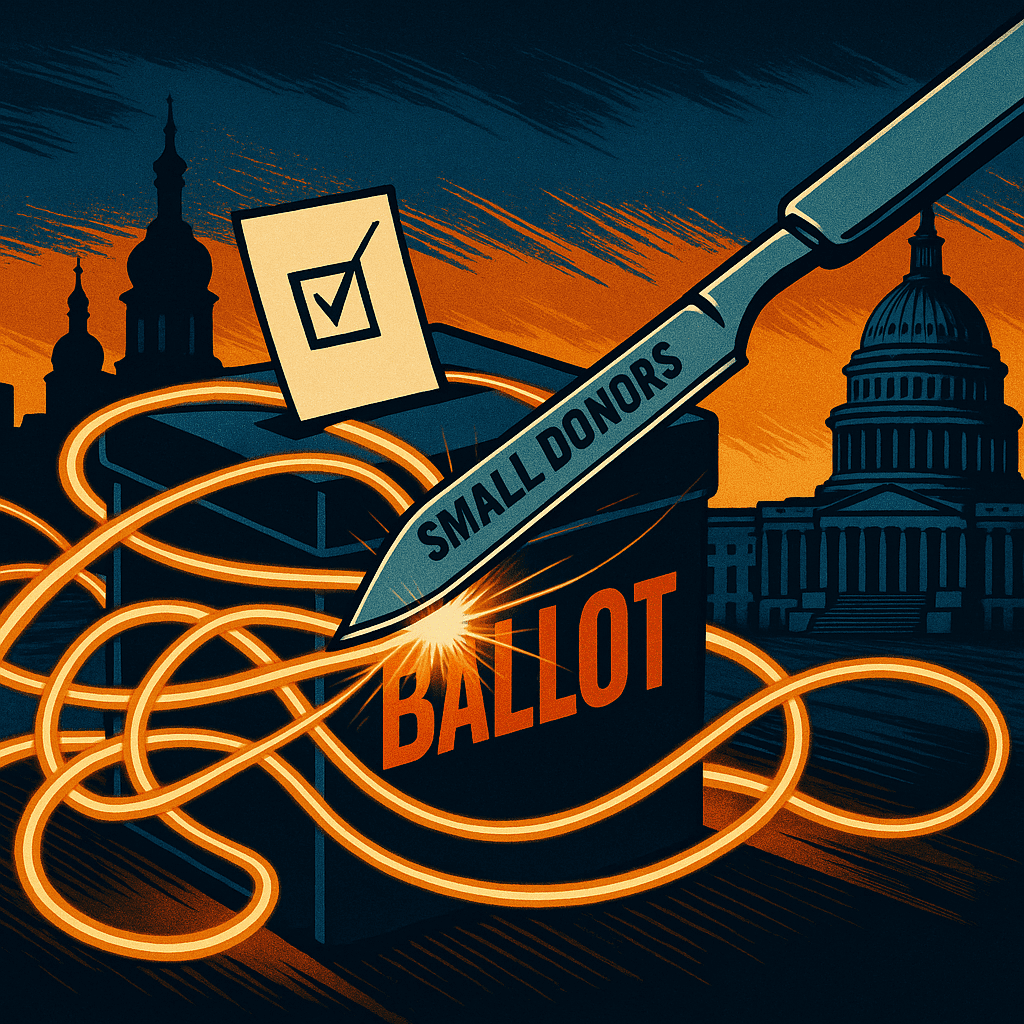
Apologies in advance: This thing gets pretty wonky. If you just want a case of genuine Wolverine ammunition to fight these bastards, scroll down to the CALL TO ACTION!!!
Ukraine tried the bold thing: a De-oligarchization law that publicly designates “oligarchs” by criteria (media control, political ties, monopoly power, massive wealth) and then blocks them from bankrolling politics and privatizations. It partially worked (one tycoon instantly ditched his TV empire), but Europe’s top democracy referees warned the law’s “name-and-shame list” risks abuse unless due-process and independence are rock-solid. Today, Ukraine is pivoting toward a more systemic anti-capture approach. In America, a copy-paste “oligarch list” would face the buzz-saw of Buckley/Citizens United/McCutcheon and likely die in court. But we can neutralize billionaire capture with fixes that do survive SCOTUS: small-donor public financing, real-time transparency for dark money, tougher foreign-influence and shell-company rules, and restoring church/political boundaries with real enforcement. (Details and receipts below.)
What Ukraine’s “De-oligarchization” law actually is
-
The law: Ukraine’s Law No. 1780-IX (“On Prevention of Threats to National Security Related to Excessive Influence of Persons with Significant Economic and Political Weight in Public Life (Oligarchs)”) was signed by President Zelensky Nov. 5, 2021. It defines an “oligarch” as anyone meeting 3 of 4 criteria: (1) participates in political life, (2) significant influence over mass media, (3) beneficial owner of a monopoly, (4) wealth exceeding a high statutory threshold (≈$80–90M). It creates a public register and bans listed oligarchs from funding parties/campaigns and from big-ticket privatizations; officials must log contacts with them. president.gov.uaVenice CommissionKyiv PostInstitute for War & Peace Reporting
-
Who runs the list: Designations are made by Ukraine’s National Security and Defense Council (NSDC) and put into effect by presidential decree; regulations for maintaining the register were set in June 2022. rnbo.gov.ua
Why it happened (and what changed after)
-
Context: Post-Soviet Ukraine has long wrestled with media-owning tycoons steering politics. The law aimed to break that loop quickly during wartime and EU-accession reforms. Europe’s Venice Commission (the Council of Europe’s constitutional advisory body) later said: the goal is right, but a personal blacklist approach needs strong due process, an independent decision-maker, and easy judicial review — otherwise it’s ripe for misuse. They urged a systemic toolkit instead (competition law, AML/beneficial-ownership, media pluralism, party-finance rules), and recommended deferring implementation until those guarantees exist. Ukraine has since postponed full implementation pending amendments after martial law ends and is updating its broader anti-capture plan. Venice Commission
-
Did it have bite? Yes, at least as a shock collar. In July 2022, Ukraine’s richest man Rinat Akhmetov abruptly exited the media business, surrendering his TV and print licenses and shutting online outlets — explicitly citing the anti-oligarch law and the media-influence criterion. News24
-
Oligarch accountability kept moving on other fronts: Ukraine also won a landmark UK High Court judgment in July 2025 ordering ex-bank owners Ihor Kolomoisky and Hennadiy Boholiubov to repay about $1.9–$2.0B over the PrivatBank fraud — a huge anti-kleptocracy signal. (Kolomoisky has faced separate criminal cases at home since 2023.) Reuters RadioFreeEurope/RadioLiberty
-
Course correction, Summer 2025: When parliament briefly passed a law weakening the independence of Ukraine’s anti-corruption agencies (NABU and SAPO), street protests erupted nationwide. Within a week, parliament reversed and restored independence — a reminder that public pressure and institutional guardrails matter more than one-off “oligarch lists.” JURISTAP News
Did de-oligarchization “work”?
Short answer: it worked as a deterrent and signal (e.g., Akhmetov ditching media), but Europe’s rule-of-law watchdogs are right — the most durable gains come from system fixes: antitrust, clean party finance, real beneficial-ownership, media pluralism, and independent anti-corruption bodies. Ukraine’s own trajectory the last two years is moving that direction. Venice Commission
Could America do this? (And would SCOTUS let it live?)
A U.S. “oligarch registry with donation bans” would almost certainly get kneecapped by existing First Amendment doctrine:
-
Buckley v. Valeo (1976): independent expenditures = core political speech; contribution limits OK to a point; expenditure caps are not. Ukrinform
-
Citizens United (2010): corporations/unions can spend unlimited independent money; disclosure still generally OK. Mezha Media
-
McCutcheon (2014): struck down aggregate contribution limits.
A law that names wealthy media owners and bars them (and only them) from political spending would look like viewpoint-discriminatory, speaker-based suppression and potentially a bill of attainder problem (punishing a class by statute). On media, the Supreme Court also let the FCC relax ownership rules in FCC v. Prometheus (2021), signaling a permissive stance toward consolidation unless Congress says otherwise. Translation: copying Kyiv’s blacklist model here is a legal dead end. Supreme Court
So what does pass muster and actually blunts billionaire capture?
The U.S. blueprint that works (and courts have blessed)
-
Supercharge small donors.
-
NYC’s 6:1 match (now 8:1 in some races) transformed who funds campaigns; candidates raise from people, not plutocrats.
-
Seattle’s Democracy Vouchers give every voter coupons to donate — diversifying donors and candidates.
These are content-neutral and have survived. Kyiv PostGeorgia Today
-
-
Relentless transparency.
Courts allow disclosure (even post–Citizens United). Congress can pass a real DISCLOSE-style law for timely, donor-level reporting on super PACs and 501(c)(4) electioneering, plus beneficial ownership of spenders. (Note: the U.S. just zig-zagged on beneficial ownership — see below.) Mezha Media -
Shut the foreign-influence backdoor.
Build on the existing foreign-money ban by blocking spending by foreign-influenced corporations (e.g., >5% single foreign owner or >20% aggregate), as Seattle and others have done. That’s constitutionally stronger than broad speech bans. OCCRP -
Fix the church/politics money pipeline.
The Johnson Amendment has long barred 501(c)(3) political endorsements, and courts have upheld IRS enforcement (see Branch Ministries v. Rossotti). But in July 2025 the IRS proposed a consent judgment narrowing enforcement for church endorsements during worship, which could open a dark-money conduit unless Congress clarifies the rule and restores enforcement resources. (Even the IRS’s own page still frames the ban; the new approach is not yet nationwide policy until the court finalizes it.) Justia Law IRS Houston Chronicle -
Media pluralism (Congressional lane).
Prometheus means the FCC can loosen ownership caps; if we want the opposite, Congress must re-set ownership limits, fund local-news support, and set tough ad-transparency rules for platforms and broadcasters. Supreme Court -
Public-company spending sunlight (SEC lane).
The SEC can require standardized political-spending disclosure from public companies (investor-protection rationale). There’s a long-standing petition and a mountain of investor comments backing this. The New Voice of Ukraine -
Beneficial-ownership transparency (Treasury lane) — update.
The 2024–25 court fights over the Corporate Transparency Act whipsawed reporting. In March 2025, FinCEN issued an interim final rule effectively removing BOI reporting for U.S. domestic companies, keeping requirements only for certain foreign entities — a major retreat. (Rulemaking still in flux.) That makes other transparency fixes even more important. FinCEN.gov
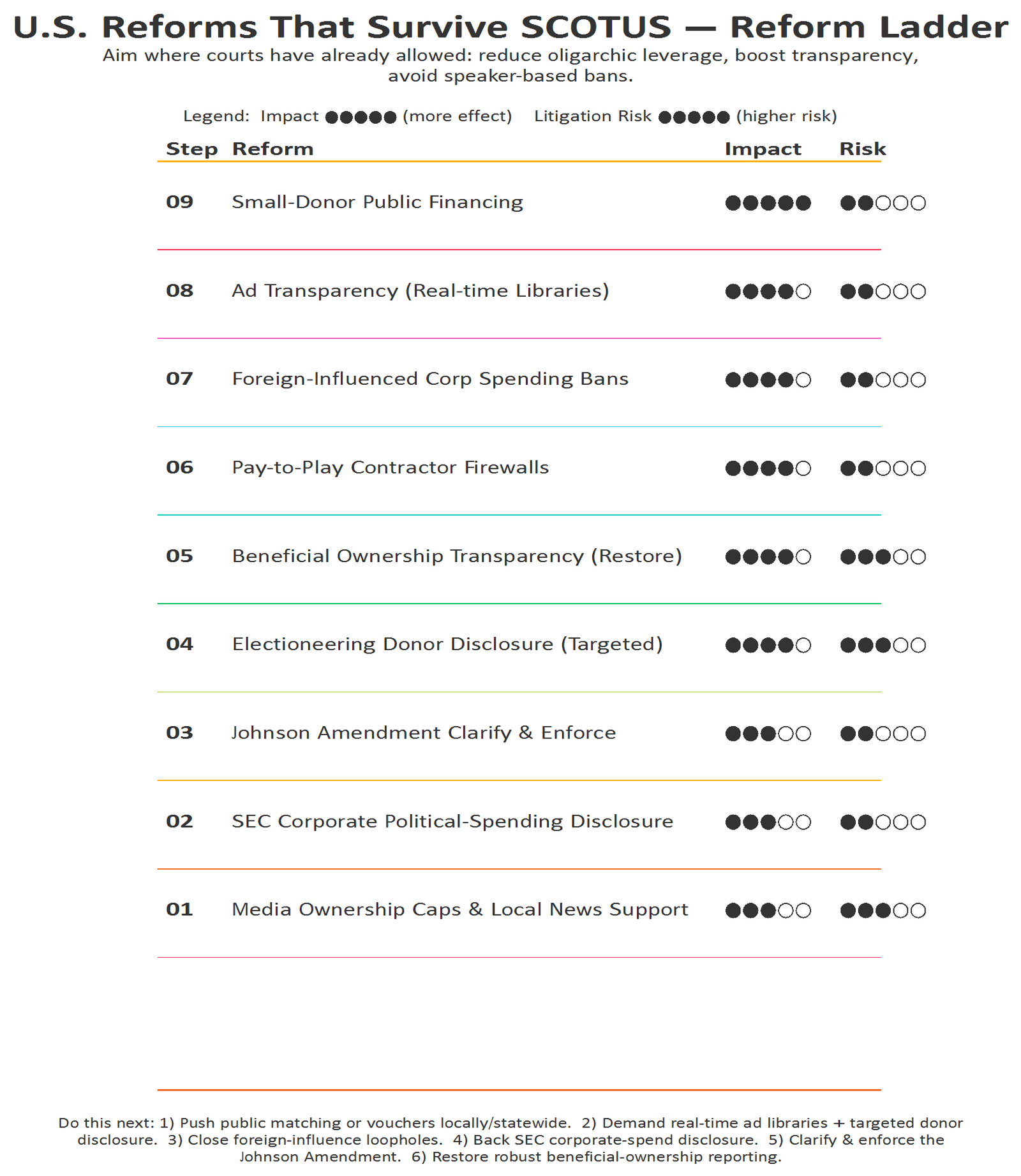
Like a copy? U.S. Reforms That Survive SCOTUS – Reform Ladder
“Now we know why Trump hates Zelensky”
Read this as analysis, not mind-reading. Zelensky’s project has aimed squarely at the model where media moguls + monopolies + dark money steer elections — the same model U.S. mega-donors lean on. When your politics is fueled by guys like Rupert Murdoch (Fox’s $787.5M defamation settlement exposed how profitable disinfo can be), the Koch network (Americans for Prosperity Action is one of the biggest outside spenders), and tech billionaires like Peter Thiel (tens of millions into 2022 Senate races) and Elon Musk (reportedly dropping large sums into GOP-aligned super PACs in 2024–25), a leader crusading against oligarchic capture is… not your favorite pen pal. Wikipedia OpenSecrets CBS News
Receipts:
-
Murdoch/Fox: $787.5M Dominion settlement in 2023. Wikipedia
-
Koch network: Americans for Prosperity Action’s outside-spending heft is extensively documented by OpenSecrets. OpenSecrets
-
Peter Thiel: ~$30–35M in 2022 federal races (Masters, Vance) — OpenSecrets. CBS News
-
Elon Musk: credible reporting in 2024–25 that he personally put significant money into GOP-aligned super PACs; amounts vary by outlet, but the direction of travel is clear — and the guy owns X, a major media vector. (Cited reporting includes Financial Times and Business Insider.) Business Insider
Far-right religious groups gaming the system
Here’s the uncomfortable truth: political money is increasingly laundered through nonprofits that are either religious or religion-adjacent because (a) donor disclosure is weaker, (b) enforcement has been thin, and (c) “we’re just preaching values” is a handy cover story for electioneering. Historically, the Johnson Amendment made the line bright, and the IRS won when it enforced it (see Branch Ministries after a church ran full-page anti-Clinton ads in 1992). Justia Law
But July 2025 introduced a twist: to settle litigation, the IRS proposed a consent judgment saying endorsements during worship are “religious speech,” not political intervention — at least for the plaintiff churches. That narrows the Johnson Amendment in practice if a judge signs off, and activist networks immediately cheered it as open season. Nonprofit and campaign-finance folks are sounding alarms because that risks turning churches into tax-subsidized super PACs with anonymous donors. Congress can (and should) clarify the statute and fund enforcement; until then, expect louder cries of “religious persecution!” whenever transparency rules bite. Houston Chronicle Politico
So what do we do here in the U.S.? (The Wolverine plan)
If we want de-oligarchization that survives this Supreme Court, we need boring-but-deadly-effective systems:
-
Pass small-donor public finance nationally (NYC/Seattle models), or at least in battleground states and big cities. This dilutes billionaires without gagging them. Kyiv Post Georgia Today
-
Real-time disclosure for super PACs and 501(c)(4)s (48-hour reporting; ultimate beneficial owners; digital ad libraries). Congress can do this; states can do it too. Mezha Media
-
Foreign-influenced corporation bans at the state/local level (Seattle-style), then push Congress to adopt. Hard to challenge, easy to copy. OCCRP
-
Re-harden the Johnson Amendment by statute, explicitly covering “in-service endorsements,” with narrow safe harbors for genuine sermons that don’t name candidates — and fund enforcement. Meanwhile, watchdog the pending IRS settlement. Houston Chronicle
-
SEC rule: mandatory, comparable corporate political-spending disclosure (shareholders > CEOs decide). Petition already exists; a new Commission could move. The New Voice of Ukraine
-
Media pluralism via Congressional caps and platform ad-transparency (FCC and FEC lanes). Prometheus says the FCC can change rules; Congress can set stronger baselines. Supreme Court
-
Rebuild beneficial-ownership transparency after the March 2025 FinCEN roll-back (or sue to vacate the IFR). Without BOI, dark-money LLCs remain the oligarch’s favorite hoodie. FinCEN.gov
Anticipating the “but the billionaires will sue!” chorus
Yep. That’s why we aim reforms where courts have already blessed government interests (preventing corruption; giving voters information; protecting shareholders; preventing foreign influence), and avoid speaker-based bans. The Venice Commission’s warning to Ukraine is our North Star too: systemic, neutral rules beat personal blacklists every time. Venice Commission
Name-checking the usual suspects
-
Rupert Murdoch: His outlets shape right-wing narratives; the Dominion payout shows the profit motive in misinformation — and why disclosure and defamation accountability matter. Wikipedia
-
Koch network/Americans for Prosperity: massive, disciplined outside spender with a 501(c)(4) hub-and-spoke. Reforms above target the structure, not just the name. OpenSecrets
-
Peter Thiel: 2022 midterms proved a single billionaire can seed entire candidacies; disclosure and small-donor match reduce that leverage. CBS News
-
Elon Musk: reported eight- and nine-figure political giving to GOP-aligned super PACs in 2024–25, while controlling a major platform (X). We fix that with transparency, not bans. Business Insider
U.S. Reforms That Survive SCOTUS
Goal: shrink billionaire leverage without banning speech, using tools courts have already tolerated.
1) Small-donor public financing (NYC/Seattle models)
-
What it does: Matches small donations (e.g., 6–8:1) so candidates raise from people, not plutocrats.
-
Why it survives: Content-neutral; furthers anti-corruption and voter-info interests.
-
Do this next: Push city/state adoption; federally, back matching + vouchers.
2) Real-time ad transparency (ad libraries + spend/targeting logs)
-
What it does: Exposes who’s paying and who’s being targeted—broadcast + platforms.
-
Why it survives: Disclosure has strong precedent when narrowly tailored to electioneering.
-
Do this next: State bills now; demand FEC/FCC/FTC platform rules and a federal DISCLOSE 2.0.
3) Electioneering donor disclosure (targeted, post-Bonta-proof)
-
What it does: Timely donor reporting for super PACs/501(c)(4)s only when they cross electioneering thresholds.
-
Why it survives: Narrow tailoring to enforcement/anti-corruption needs.
-
Do this next: Tight thresholds + fast reporting (24–48h).
4) Foreign-influenced corp spending bans
-
What it does: Bars election spending by U.S. companies with meaningful foreign ownership/control.
-
Why it survives: Builds on longstanding foreign-money prohibitions.
-
Do this next: Copy Seattle-style thresholds at city/state level; press Congress for a federal version.
5) Pay-to-play contractor firewalls
-
What it does: Limits donations tied to government business (muni finance, state contracts, pensions).
-
Why it survives: Directly targets quid-pro-quo risk; long track record (MSRB/SEC).
-
Do this next: Expand smart, risk-based rules in procurement hot spots.
6) SEC corporate political-spending disclosure (shareholder control)
-
What it does: Standardized reporting + shareholder say before corporate treasury funds go to politics.
-
Why it survives: Investor-protection/ fiduciary-governance frame; viewpoint-neutral.
-
Do this next: Support the rulemaking petition; file shareholder proposals.
7) Beneficial-ownership transparency (restore + strengthen)
-
What it does: Unmasks shell LLCs that launder dark money.
-
Why it survives: AML/anticorruption rationale; can be scoped and privacy-safe.
-
Do this next: Push Treasury/Congress to restore robust U.S. BOI reporting after recent rollbacks.
8) Media pluralism (ownership limits + local news support)
-
What it does: Reduces single-mogul choke points in the information pipeline.
-
Why it survives: Structural competition policy; not content regulation.
-
Do this next: Congressional caps on cross-ownership; targeted local journalism support.
9) Johnson Amendment—clarify & enforce
-
What it does: Re-draws the bright line: 501(c)(3)s (incl. churches) don’t endorse candidates.
-
Why it survives: Longstanding; courts have upheld enforcement.
-
Do this next: Codify that endorsements-in-service still count; fund IRS enforcement.
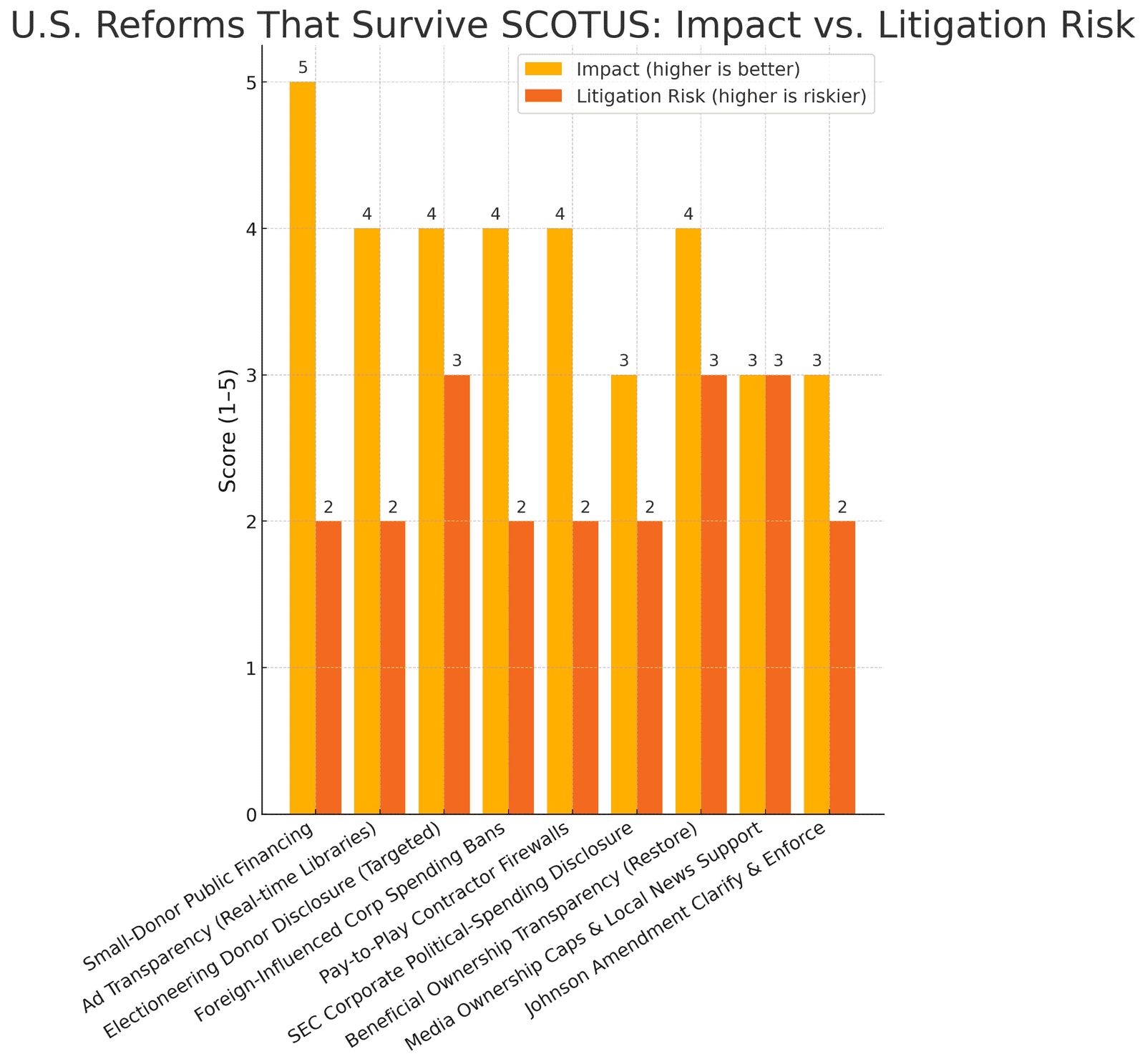
Like a copy? U.S. Reforms That Survive SCOTUS – Impact vs Litigation Risk
Call to Action — Wolverines, Mount Up!
We don’t need permission from billionaires to clean up our democracy. We need discipline, receipts, and a swarm. If this post hit home, don’t just nod—move.
The 5-Minute Wolverine Blitz
Download a PDF of the Reform Ladder
Download a PDF of the Impact vs Risk Chart
-
Localize power: Find your city/state rep’s email. Subject: “Ad Transparency + Small-Donor Match—Bring It Here.”
Body (paste):I’m a constituent asking you to sponsor two clean-elections bills: (1) real-time ad libraries for all political ads (who paid, how much, who was targeted), and (2) small-donor public financing (NYC/Seattle model). Both reduce corruption risk without banning speech. Please reply with next steps.
-
Shut the backdoor: Email your city clerk/council:
Please adopt a foreign-influenced corporate spending ban (Seattle-style thresholds). It builds on existing foreign-money prohibitions and protects local elections.
-
Hold corporate spend to sunlight: If you own any public company stock (even via IRA/401k), submit a shareholder note:
I support an SEC rule requiring standardized disclosure of corporate political spending and a shareholder vote before treasury funds are used for politics.
-
Protect the church/state line: Call your U.S. House member:
Codify and fund enforcement of the Johnson Amendment so tax-exempt nonprofits don’t become dark-money super PACs.
-
Amplify the map: Share this post with 3 people who vote every cycle. Add: “Pick one action above. Tell me which one you did.”
One-Minute Phone Script (for reps’ staff)
Hi, I’m [NAME], a constituent in [CITY/ZIP]. I’m calling to support two anti-corruption reforms that survive the Supreme Court: (1) small-donor public financing and (2) real-time ad transparency. These reduce pay-to-play without restricting speech. Will [OFFICIAL] sponsor and publicly back them this session? I’d love a follow-up email at [EMAIL]. Thanks.

0 Comments