

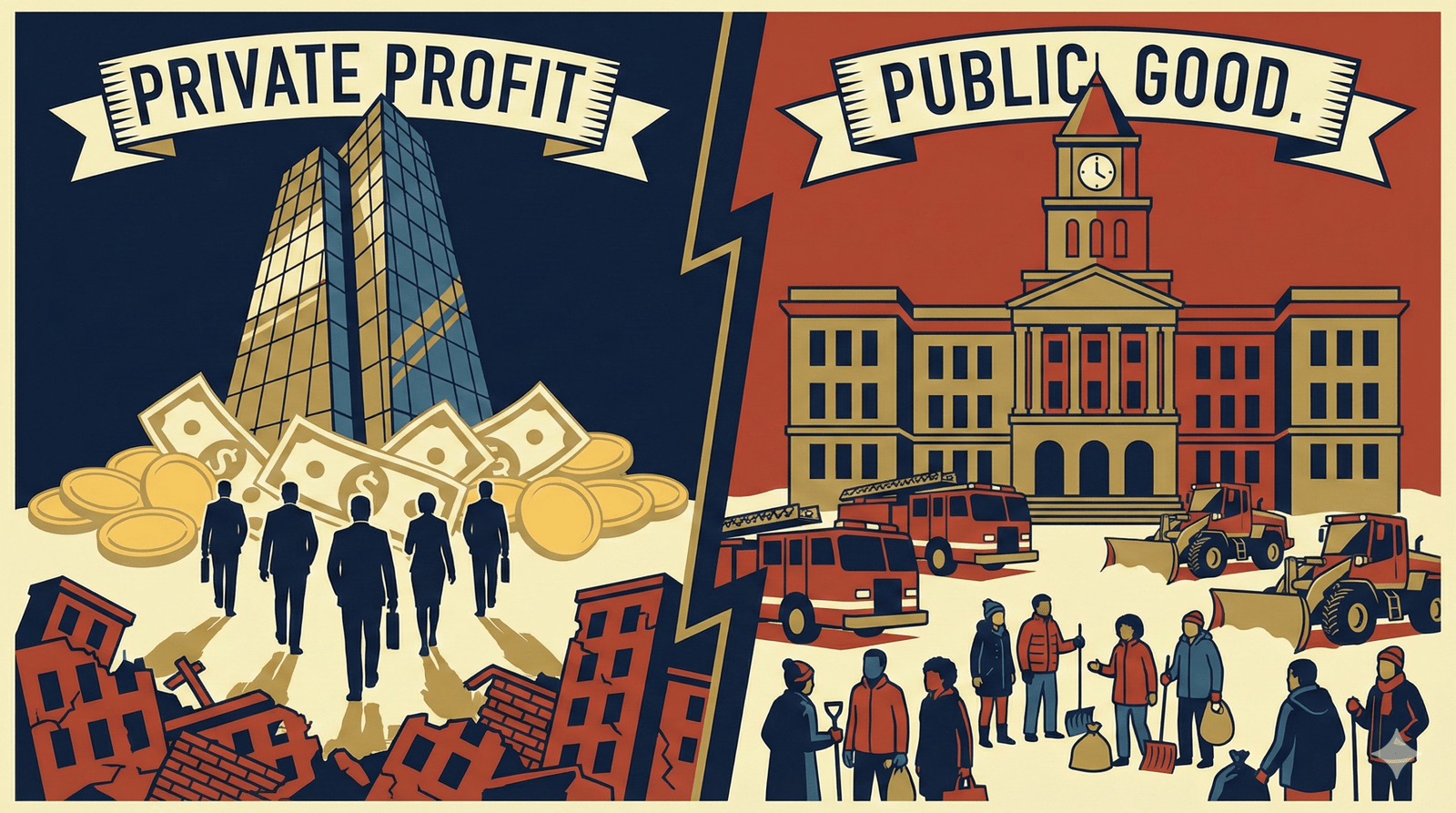
If you want a preview of how this debate really works, don’t start with spreadsheets or talking points.
Start with a sword.
Once upon a time, a group of wealthy landowners dragged King John of England out to a meadow and basically said, “Sign this or else.” The document he signed—what we now call the Magna Carta—is often romanticized as the birth of rights and limits on power. In practice, it was a group of early shareholders forcing the monarch to stop treating the entire country like a personal piggy bank and, for the first time, putting the crown under written law instead of pure whim.
Fast-forward a few centuries. The swords are gone, but the power play isn’t. Only now, it isn’t nobles with steel. It’s corporations with cash.
They don’t need a battlefield. They have tax cuts, lobbyists, dark-money PACs, and a transactional president who can be legally bribed, flattered, and steered like a shopping cart with one busted wheel.
So let’s talk about government vs corporations. Who’s actually better at running a country—and why the whole “government should be run like a business” line is one of the most dangerous marketing slogans ever sold to voters.
When Corporate Power Puts the Crown in a Headlock
The fantasy version of capitalism says businesses compete, innovate, and make life better for everyone. Sometimes they do. You like antibiotics and smartphones? Thank a mix of public research (very often funded by government grants) and private industry.
But the modern corporate game isn’t just about selling products. It’s about buying the rulebook.
Tax cuts written to benefit a handful of industries. Deregulation crafted by the very companies that will “self-police.” Loopholes so large you could drive a private jet through them—and sometimes literally do.
And when corporations cross the line, notice how rarely anyone in the executive suite goes to prison. Most of the time, the company pays a fine that amounts to a rounding error on last quarter’s profits. That’s the dark side of corporate “personhood”—a legal framework that treats corporations as “persons” for constitutional purposes. The paperwork takes the blame; the people who made the decisions skate.
Take Boeing. After two 737 MAX crashes killed hundreds of people, the company faced fraud charges and public outrage. The endgame? Multi-billion-dollar settlements and deals that let the corporation pay, promise, and move on—while executives largely avoided personal accountability.
That’s not a free market. That’s a hostile takeover of democracy.
And when you put a transactional president in the middle of that—someone who treats public office like a loyalty-points program for wealthy donors—you don’t just get bad policy. You get a government that openly posts a “For Sale” sign on the White House lawn.
At that point, asking whether government or corporations are “more efficient” is like asking whether you’d rather be robbed by a mugger or an embezzler. The problem isn’t efficiency.
The problem is who the system is designed to serve.
What Government Is For (Hint: Not Profit)
One of the loudest complaints from Republicans and their favorite business pundits is that government is wasteful and inefficient.
You know what? Sometimes it is.
But here’s the part they leave out: government has to do things no corporation would touch without a guaranteed profit stream.
Take Brooklyn Center, Minnesota.
Big-box stores used to anchor that community—Walmart, Target, Kohl’s, Sears, and more. Then the math stopped working. Not enough income in the area. Higher crime rates. Shrink from theft, including by employees.
The corporate solution? Leave.
When the numbers look bad, a corporation can shut the doors, lock the building, and move its “investment” to a wealthier ZIP code. They aren’t legally required to care what happens to the people left behind.
But government doesn’t have that option.
The city of Brooklyn Center still needs police, fire, ambulances, roads, snow removal, water, sewage, and a dozen other basic services that keep people alive and businesses—what’s left of them—operating. Just imagine if your government said, “Trash hauling is no longer profitable. You’re on your own.” Or, “We can’t afford to clean your water anymore. Drink at your own risk.”
Government can’t say, “Sorry, this neighborhood isn’t profitable, we’re out.” If you want a system that can’t walk away when things get hard, you don’t pick corporations. You pick government.
That “inefficiency” people complain about? A lot of it is what it costs to show up for everyone, not just the customers with the best credit scores.
Why “Run Government Like a Business” Is a Rigged Question
“Government should be run like a business” sounds reasonable, right up until you think about what a business actually does.
A business is built to:
- Maximize profit
- Minimize cost
- Walk away from anything that doesn’t pencil out
A government is supposed to:
- Protect and serve the people
- Provide public goods that don’t make money (roads, schools, disaster response, public health)
- Treat residents as citizens, not as customers you can fire
Those missions are not just different—they’re fundamentally incompatible.
If you ran government like a business, you’d:
- Shut down services to poorer communities because they aren’t “profitable”
- Cut corners on safety because fines are cheaper than prevention
- Measure success by shareholder return instead of human outcomes
We’ve already seen what that looks like.
Remember Obion County, Tennessee? For years, rural residents there had to pay a small subscription fee for fire protection. One family’s house caught fire; they hadn’t paid the fee. Firefighters showed up—only to make sure the flames didn’t spread to a neighbor who had paid. They stood and watched the house burn to the ground because it wasn’t “on the list.”
That’s what “no pay, no service” looks like when you apply it to basic survival.
And here’s the kicker: once you demand that government operate on pure cost-cutting “efficiency,” you immediately create excuses to:
- Slash staffing levels
- Delay maintenance
- Gut regulatory agencies
- Outsource everything to the lowest bidder
Then, when things inevitably fall apart, the same people who cut the budget point to the broken system and say, “See? Government doesn’t work. Better let business handle it.”
It’s not a bug. It’s a strategy.
And, yes, under a system like that, you might only be charged for the services you use. But the quality will be based on which “tier” you paid for or worse yet, may only be offered to the highest bidders.
If you’re not wealthy, where does that leave you?
Watchdogs, Inspectors, and the Cost of Keeping Us Safe
Corporations love to talk about how much regulation costs them. You don’t hear as much about the cost of not regulating them.
The only thing standing between a lot of workers and preventable injury—or worse—is a government agency with enough funding and teeth to say, “No, you can’t do that.”
Think about:
- OSHA, making sure people don’t die at work just because safety equipment cuts into quarterly profits.
- Building inspectors, making sure the house you buy isn’t a future collapse built on shortcuts.
- Licensing boards, keeping fly-by-night operators from turning home repairs into expensive disasters.
These watchdogs exist because corporations have repeatedly shown that they will not “self-police” when there’s serious money on the table.
And what happens whenever Republicans get power?
They don’t usually try to eliminate these agencies outright. That would be obvious and unpopular.
Instead, they starve them.
They cut staff. Freeze hiring. Slash enforcement budgets—especially for agencies like the IRS that actually bring in more money than they cost when allowed to do their jobs.
The result is a system that still exists on paper but can’t actually protect people in practice. Corporations get the freedom to push the line. Ordinary people get the consequences.
Look at Lina Khan, the former head of the Federal Trade Commission. She took her job seriously. She went after corporate monopolies and abusive practices. She treated the word “watchdog” like an actual job description instead of a decorative title.
And when Trump got into power, she was one of the first to be shown the door.
The message is clear: you can have regulators, as long as they don’t regulate too much.
And if you think deregulation is harmless, remember the Savings & Loan crisis. In the 1980s, new laws “freed” S&Ls to take on riskier loans and pay higher interest to chase deposits. For a little while, it looked profitable. Then the bad bets collapsed, hundreds of institutions failed, and taxpayers were left holding a bailout bill in the hundreds of billions of dollars.
The Lobbyist Revolving Door: When Corporations Write the Rules
Lobbyists are the people corporations hire to translate money into policy. Their job is simple:
- Write entire chunks of legislation
- Hand them to friendly legislators
- Make sure the donors get what they paid for
Sometimes those lobbyists used to work inside government. They know exactly how the machine works. That’s the revolving door in action: public servants walk out of office and stroll straight into high-pay lobbying jobs for the industries they used to oversee.
So when people say business should “have a seat at the table” when laws are written—fine. Let them testify in hearings. Let them submit comments. Let them argue their case in public.
But they should not be allowed to:
- Literally write the bills
- Hide their fingerprints in dense legal language
- Pour unlimited money into campaigns to punish any legislator who says no
If you’ve ever wondered why some laws seem weirdly tilted toward one specific industry, or why penalties for corporate crime are often less than the profit made by committing it, that’s why.
You don’t get democracy when the rulebook is drafted in a boardroom. They say money can’t buy everything, but it can buy a version of “democracy” that tilts every close call toward the wealthy.
Fixing Government Without Handing It to CEOs
None of this means government gets a free pass.
There is waste. There is bureaucracy. There are agencies running on software that should have been retired around the time dial-up died.
The solution, though, is not to burn it all down and hand the rubble to corporations.
If you actually wanted a more effective government that serves people better, you’d:
- Modernize the tools
Update ancient systems, invest in secure modern tech, and stop forcing agencies to duct-tape 1970s software to 2020s problems. If you ever see a shiny new “efficiency task force” that mostly talks about layoffs and data harvesting—call it D.O.G.E. or whatever you like—assume it’s there to gut capacity, not to help public servants do their jobs better. - Listen to the people doing the work
Front-line staff know exactly where the bottlenecks are. Agencies should have real input into legislation that affects their ability to function. - Measure what matters
Instead of mindless “cut 10% from every department” drills, measure outcomes: safety, health, response time, fairness. Fund what works, fix what doesn’t. - Charge corporations for the real cost of oversight
Inspections, enforcement, audits—none of this is free. If your business model only works when nobody is watching, it’s not a business model. It’s a red flag. Another way to look at it: organized crime is just a “business” that collapses the moment you enforce basic rules. - Shut the revolving door
Impose an outright ban on former top officials lobbying on behalf of industries they oversaw, and bright-line bans on writing legislation for those same sectors. At a minimum, long cooling-off periods and aggressive oversight should apply to anyone who walks straight from the Pentagon into a corner office at a major defense contractor. - Protect the watchdogs instead of defunding them
Agencies like the IRS, OSHA, and consumer protection offices should be strong enough to deter bad behavior before it starts, not just sweep up after disasters.
That’s how you make government more effective without turning it into a customer-service department for billionaires.
Pick a Side: Shareholders or Citizens?
At the end of the day, this isn’t really a question about “efficiency.”
Corporations are efficient at one thing: generating profit.
Government, at its best, is “inefficient” in all the right ways. It spends money on:
- Communities that are not profitable
- People who will never be donors
- Infrastructure that doesn’t show a quarterly return but keeps entire regions alive
When Republicans and their corporate sponsors wail about government waste, what they usually mean is, “You’re spending money on people we don’t care about.”
You can absolutely demand better government. Smarter government. More transparent, accountable, and responsive government.
What you cannot do—if you want a functioning democracy—is hand control of the rulebook to the same corporations that already captured the economy and then pretend you’re shocked when they start treating the country like another strip-mall location they can close when profits dip.
So when someone tells you government should be run like a business, ask a simple question:
For whose benefit?
Shareholders—or citizens?
If you’re on the side of citizens, you’re going to need more than slogans. You’re going to need:
- Fully funded watchdogs
- Real limits on lobbyists and the revolving door
- A government that can’t walk away when things get tough
That’s the fight.
No Wimps Army, Wolverines—choose your side and act accordingly.


0 Comments