

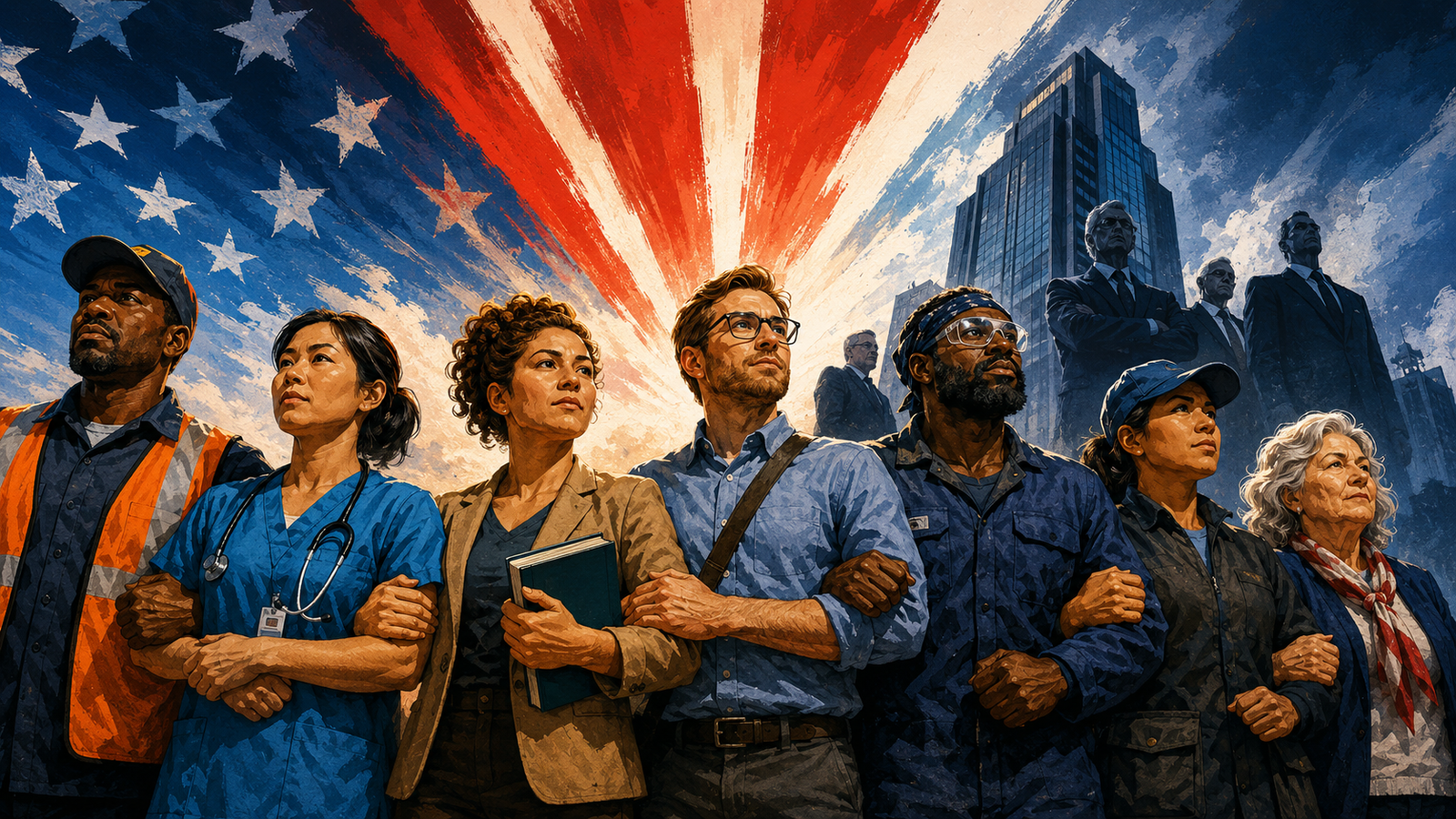
“Why won’t the government save us?”
And start asking the useful one:
“What power do we still have when the government is busy polishing the boots of billionaires?”
Because let’s not kid ourselves. Trump does not have the back of working Americans. He has the back of oligarchs, billionaires, corporate predators, billionaire donors, fossil-fuel barons, anti-worker executives, and every gold-plated vulture currently circling the carcass of the middle class.
The man does not see workers as citizens.
He sees them as props.
He sees hard hats as campaign costumes. He sees truckers, factory workers, nurses, teachers, veterans, grocery clerks, warehouse workers, drafters, mechanics, janitors, drivers, and office workers as background extras in the Donald Trump Variety Hour.
Smile. Clap. Wear the hat. Blame immigrants. Blame teachers. Blame “woke.” Blame whoever the billionaire class tells you to blame this week.
Just do not, under any circumstances, look up and notice who owns the building.
Because once ordinary Americans notice that the real fight is not left versus right, but workers versus oligarchs, the whole scam starts shaking like a cheap card table at a casino run by cousins.
And that brings us to the word they really do not want working people saying out loud:
Union.
Not as nostalgia.
Not as some dusty black-and-white photograph of factory workers with lunch pails.
Not as a museum exhibit from the Age of Decent Pensions.
But as a living, breathing, brass-knuckled democratic tool for taking power back.
Collective Bargaining Power Is Democracy at Work
Let’s start simple.
A worker alone is easy to ignore.
A worker alone can be underpaid, overworked, gaslit, replaced, scheduled into exhaustion, threatened with discipline, denied raises, denied benefits, denied safety, denied dignity, and then handed a corporate-branded water bottle during “Employee Appreciation Week.”
How generous. How inspiring. Truly, the Pharaoh has smiled upon the bricklayers.
But workers together?
That is a different animal.
Workers together can say:
No.
Not “pretty please.”
Not “we hope management considers our concerns.”
Not “thank you for allowing us to participate in this anonymous engagement survey that will be buried in a spreadsheet and never spoken of again.”
No.
No, we will not accept poverty wages.
No, we will not accept unsafe conditions.
No, we will not accept random scheduling that destroys family life.
No, we will not accept executives buying third vacation homes while workers choose between prescriptions and groceries.
No, we will not accept being treated as disposable machine parts in the sacred name of shareholder value.
That is collective bargaining power.
And that is why the rich hate it.
Ever heard Republicans try to tell you organized labor is socialism? It’s communism? It’s “woke”?
That’s what you say when you’re owned lock, stock, and barrel by the rich.
Those of us who work for a living know better.
The Rich Do Not Fear Your Opinion. They Fear Your Organization.
The billionaire class does not care if you are angry.
Anger is fine.
Anger can be monetized. Anger can be harvested for clicks. Anger can be redirected into culture-war nonsense. Anger can be aimed sideways at your neighbors while the executive suite quietly moves another truckload of cash out the back door.
What the billionaire class fears is organization.
Workers talking to each other.
Workers comparing pay.
Workers realizing the “company family” somehow has one branch living in mansions and another branch using payday loans.
Workers forming committees.
Workers contacting unions.
Workers building strike funds.
Workers supporting other workers.
Workers understanding that democracy does not stop at the factory gate, the warehouse scanner, the hospital time clock, the classroom door, or the office cubicle.
The National Labor Relations Act protects the right of covered employees to form, join, or assist unions, bargain collectively, and engage in protected concerted activity for mutual aid or protection. The NLRB also says workers generally have the right to act together with coworkers to improve pay and working conditions, even without a union.
That is not charity.
That is power.
And power is the only language oligarchs understand fluently.
Reagan Sent the Signal. Corporate America Heard It.
Ronald Reagan did not invent anti-union politics.
But he did send one of the loudest modern signals that the federal government was no longer standing behind organized labor.
In 1981, when members of the Professional Air Traffic Controllers Organization went on strike, Reagan fired 11,345 of them. The Miller Center records that firing as one of the defining moments of his presidency. Legally, that strike had complications because federal workers faced limits on striking. But politically, the message was much bigger than one labor dispute.
Corporate America watched.
Union-busters watched.
Executives watched.
The message was simple:
The referee has joined the other team.
After that, the long corporate offensive accelerated. Bust the unions. Outsource the jobs. Privatize the gains. Socialize the pain. Tell workers to “reskill” while executives cash bonus checks big enough to choke a dragon.
And now here we are, decades later, with an economy where workers are told they are “essential” right up until they ask to be paid like it.
Union Decline Hurt Nonunion Workers Too
This is the part too many people miss.
Unions do not only help union members.
They raise the floor for everybody nearby.
I saw this myself during my 23 years as a draftsman in Detroit. I was not in a union. But I knew how the weather worked. When union workers won raises, office workers often benefited too. Not because management suddenly discovered generosity in a drawer next to the printer toner.
Because the standard had moved.
That is the union spillover effect.
When union workers bargain successfully, nonunion employers often have to raise wages or improve conditions to compete for workers. The U.S. Treasury Department reported that each one-percentage-point increase in private-sector union membership is associated with about a 0.3% increase in nonunion wages, with larger benefits for workers without a college degree.
That means your neighbor’s union contract may help your paycheck.
That means the nurse bargaining for safe staffing may help the patient.
That means the teacher fighting for classroom support may help the student.
That means the warehouse worker demanding humane conditions may help reset what every employer in town has to offer.
That is why oligarchs do not want strong unions.
Because strong unions do not merely redistribute money.
They redistribute power.
The Collapse Was Not an Accident
In 1983, the first year with comparable federal data, 20.1% of wage and salary workers were union members. By 2025, the union membership rate was 10.0%, according to the U.S. Bureau of Labor Statistics.
That did not happen because workers suddenly decided they hated weekends, pensions, overtime rules, safety standards, and having a say in their own working lives.
It happened because corporations spent decades attacking labor power.
It happened because Republicans weakened enforcement.
It happened because trade policy helped companies move production away from union-heavy communities. NAFTA was signed in 1992 and entered into force on January 1, 1994, according to U.S. Customs and Border Protection and the Office of the U.S. Trade Representative.
It happened because “right-to-work” laws were marketed as freedom while quietly functioning as union starvation devices.
It happened because the rich figured out that a worker alone can be squeezed, but workers together can squeeze back.
And so they spent decades breaking the “together.”
They sold us individual hustle instead of collective power.
They sold us gig work instead of careers.
They sold us “be your own brand” while corporations became monopolies.
They sold us workplace apps, productivity dashboards, and cheerful HR slogans while wages lagged behind the cost of actually existing on planet Earth.
And then, when people got mad, they handed them scapegoats.
Immigrants.
Trans kids.
Teachers.
Librarians.
College students.
Civil servants.
Anyone but the billionaires holding the bag.
Nice trick.
Old trick.
Rotten trick.
Trump’s Anti-Worker Game Is Not Subtle
Trump talks like a populist when he wants votes.
But policy is where the mask slips.
On March 27, 2025, Trump issued an executive order titled “Exclusions from Federal Labor-Management Relations Programs”, excluding multiple federal agencies and subdivisions from federal labor-management relations rules. The order was framed around national-security functions, but its practical meaning was an attack on collective bargaining for large categories of federal workers.
That is not pro-worker.
That is not “forgotten Americans.”
That is not “drain the swamp.”
That is a wrecking ball aimed at collective bargaining.
And once again, the lesson is clear:
Do not wait for permission from politicians who dine with billionaires.
Build power where you stand.
The Revolution Starts at Work
Now, let’s be clear. I am not talking about violence.
Violence is what desperate fools and authoritarian creeps reach for when they cannot organize, persuade, or build durable power.
The revolution I am talking about is older, tougher, smarter, and far more terrifying to the rich:
Workers talking to workers.
Neighbors supporting workers.
Consumers backing union shops.
Communities showing up for strikes.
Voters punishing union-busters.
Retirees using their time and experience to support organizing drives.
Professionals refusing to sneer at blue-collar workers.
Blue-collar workers refusing to be conned into hating public workers.
Public workers refusing to forget private-sector workers.
Young workers refusing to accept an economy where every job is temporary, every rent is obscene, every medical bill is a threat, and every billionaire wants applause for “creating opportunity” while paying poverty wages.
This is how power comes back.
Not all at once.
Not magically.
Not because some savior rides down the escalator in bronzer and lifts the people with his tiny, golden hand.
Power comes back when ordinary people stop waiting to be rescued and start linking arms.
What Ordinary Citizens Can Actually Do
Here is the practical part.
First, talk about wages.
The boss class loves secrecy because secrecy keeps workers weak. When nobody knows what anybody else makes, management can underpay people one at a time.
Second, learn your rights.
Covered workers have rights to organize, discuss working conditions, solicit support during non-work time in non-work areas, and sign union authorization cards. The NLRB explains that if at least 30% of workers sign cards or a petition asking for union representation, the agency can conduct an election; employers can also voluntarily recognize a union based on majority support.
Third, do not play lone hero.
This is not a cowboy movie. This is a team sport. Talk quietly. Build trust. Identify respected coworkers. Listen more than you preach. Find out what people actually care about: wages, schedules, safety, health insurance, staffing, abusive managers, forced overtime, impossible quotas.
Fourth, connect with experienced organizers.
Do not reinvent the wheel with duct tape and caffeine. Many unions, worker centers, and labor organizations already know how to help workers assess risks, map the workplace, build committees, and avoid obvious traps.
Fifth, support other workers publicly.
When workers strike, do not cross picket lines. Donate if you can. Share their statements. Bring food. Show up. Make noise. Treat their fight like it matters because it does.
Sixth, make union-busting politically expensive.
Any politician who claims to love workers while attacking collective bargaining should be treated like a smoke alarm salesman setting fires in the basement.
Seventh, rebuild solidarity across job types.
The rich have spent decades teaching workers to resent each other. Private workers versus public workers. Office versus shop floor. Native-born versus immigrant. Young versus old. Degree versus no degree. Rural versus urban.
Every one of those divisions is a gift basket for oligarchs.
Stop delivering gift baskets.
This Is Bigger Than Paychecks
Yes, unions fight for wages.
Good.
Wages matter.
Rent is not paid in vibes. Groceries are not purchased with inspirational LinkedIn posts. Medical bills do not vanish because the CEO used the phrase “we’re all in this together” during a quarterly call.
But unions are about more than paychecks.
They are about dignity, on-the-job safety, family-first.
They are about democracy.
They are about having a say in the place where many people spend half their waking lives.
They are about forcing power to negotiate instead of dictate.
They are about reminding corporations that workers are not human packing peanuts stuffed around executive bonuses.
And they are about rebuilding the civic muscle America has allowed to atrophy.
Because a nation of isolated, terrified, exhausted workers is easy to rule.
A nation of organized citizens is not.
The Billionaire Class Wants You Alone
That is the whole game.
Alone with your debt.
Alone with your rent.
Alone with your medical bills.
Alone with your algorithmically scheduled gig shift.
Alone with your anxiety.
Alone with your shame because you work hard and still cannot get ahead.
Alone with the sneaking suspicion that maybe you failed.
You did not fail.
You were out-organized.
The rich organized.
Corporations organized.
Lobbyists organized.
Think tanks organized.
Trade associations organized.
Billionaires organized.
They organized tax policy, labor policy, trade policy, media narratives, court appointments, campaign finance, and the entire moral mythology of “job creators” being carried around like sacred cows in tailored suits.
So yes, ordinary people need to organize too.
Not because it is quaint.
Because it is necessary.
No Wimps Army: This Is Where We Start
So here is the call.
If you are in a workplace, start listening.
If you are retired, support workers who are organizing.
If you are a professional, stop pretending unions are only for “other people.”
If you are working class and conservative, ask yourself why billionaires spend so much money convincing you unions are bad.
If you are liberal, stop treating labor as a slogan and start treating it as infrastructure.
If you are young, understand this: you do not have to inherit a shredded economy and call it freedom.
If you are old enough to remember when one income could support a family, say so loudly. Tell the younger people they are not lazy. Tell them the ladder was pulled up.
And if you are part of the No Wimps Army — Wolverines — this is where the fight gets real.
Not just posts.
Not just memes.
Not just outrage.
Power.
Workplace power.
Community power.
Economic power.
The billionaire class already has money.
The government may be captured, compromised, cowardly, or just busy serving cocktails in the oligarch lounge.
But workers still have numbers.
Workers still have skill.
Workers still have leverage.
Workers still have each other.
And when ordinary citizens remember that, the rich start checking the locks.
Because the most dangerous sentence in American politics is not “Someone should do something.”
It is:
We are doing something together.
That is how citizens take power back.
That is how workers stop begging.
That is how democracy gets off the floor.
And that, my friends, is where the next American labor revolution begins.
Sources and Further Reading
- U.S. Bureau of Labor Statistics — Union Members 2025
- Miller Center — Reagan vs. Air Traffic Controllers
- National Labor Relations Board — National Labor Relations Act
- National Labor Relations Board — Your Right to Form a Union
- U.S. Treasury Department — Labor Unions and the U.S. Economy
- White House — Exclusions from Federal Labor-Management Relations Programs
- Office of the U.S. Trade Representative — NAFTA Archive

0 Comments