

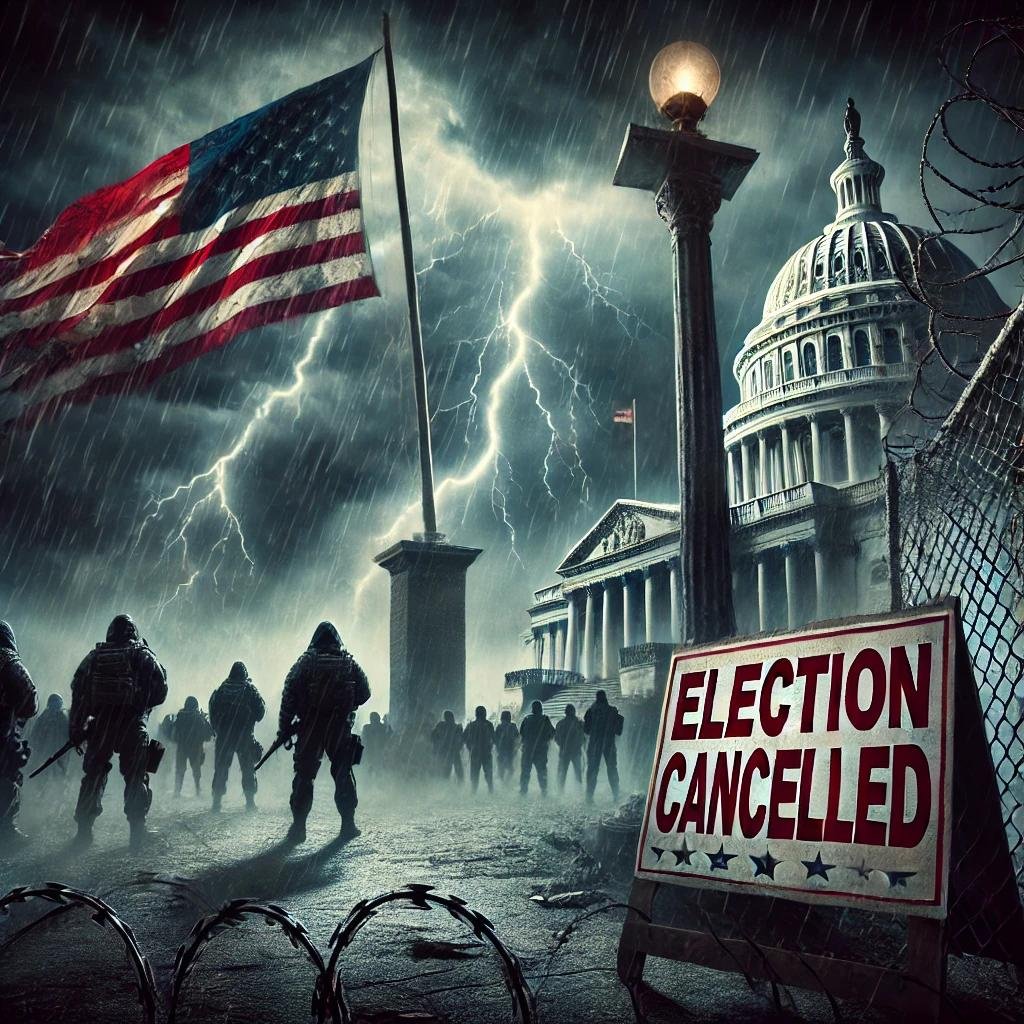
If I ran the Heritage Foundation, and I spent four years crafting a playbook to turn the United States into a Christian Nationalist Fascist dictatorship (think The Handmaid’s Tale but with real-world consequences, or for those historically inclined, General Francisco Franco’s fascist, nationalist, and Catholic Church-aligned dictatorship), you’d better believe I wouldn’t leave its survival up to the whims of democracy. Because here’s the thing: real authoritarians don’t just seize power. They hold onto it by ensuring there’s no legal way to take it back.
I’ve read enough about Mussolini, Hitler, Tojo, Putin, Erdoğan, and other strongmen who pulled off “legal” coups to know that once you have the executive branch, the legislature, the judiciary, and the justice system in your pocket, you don’t just hope the next election goes your way—you make damn sure it does. And if you can’t, well… who says you have to hold an election at all?
So, let’s walk through it: How exactly could a U.S. president who controls the executive branch, the House and Senate, the Supreme Court, the Justice Department, the FBI, and state legislatures across the country just cancel elections—or make them a foregone conclusion? Turns out, there are plenty of ways.
Step 1: Erode Election Legitimacy Before It Happens
You don’t have to cancel elections outright if you can make half the country believe they don’t count. This is the first and easiest step. It’s already happening.
Donald Trump spent months before the 2020 election laying the groundwork for his “stolen election” lie. By November, a significant chunk of Republicans believed the election was rigged before a single vote was counted. Imagine an administration that doesn’t just whine about fraud but actually manufactures enough chaos that no one can say with certainty who won—or if votes were counted at all.
Disqualify candidates? Already happening. Look at how Republican-controlled states are trying to bar political opponents from the ballot (see Colorado and Maine ruling Trump ineligible under the 14th Amendment). Now flip that power dynamic: if the GOP controls the courts, who do you think is getting removed from ballots?
Voter roll purges? Also happening. In 2023, Georgia officials quietly removed over 100,000 voters from the rolls. If you don’t want to risk an election loss, why not just make sure the other side’s votes never count?
Gerrymandering? Already so extreme that in places like Wisconsin and North Carolina, the party in power can lose the popular vote and still maintain a supermajority.
All of these tactics precede any election cancellation, ensuring that if a vote is held, it’s under rules rigged beyond recognition.
Step 2: Manufactured Crisis = No Election
If all else fails, just declare a national emergency.
History tells us authoritarians don’t usually cancel elections outright. Instead, they create the conditions that make them “impossible” to hold—at least until further notice.
Here are a few options:
- Mass civil unrest. If enough violence erupts before an election, a president could declare a state of emergency and suspend normal electoral procedures. The Insurrection Act allows the military to be deployed domestically.
- Foreign war escalation. If the U.S. enters a large-scale war, an administration could invoke emergency wartime powers to delay an election “for national security reasons.”
- Cybersecurity attack on voting infrastructure. A few conveniently timed cyberattacks on voting machines could create enough doubt that officials claim it’s “unsafe” to hold an election at all.
This isn’t a hypothetical. Russia used war to justify eliminating competitive elections. Turkey did the same after a failed coup. If authoritarians around the world use these tactics, why wouldn’t an American one?
Step 3: The Courts Rubber-Stamp It
Even if a president tried to pull off something as blatantly unconstitutional as canceling elections, it still has to hold up legally, right?
Not if you already control the courts.
The U.S. Supreme Court, stacked with justices selected through the Federalist Society pipeline, has repeatedly demonstrated a willingness to rule in favor of executive power, state control over elections, and extreme legal interpretations of the Constitution.
In 2023, the conservative justices seriously entertained the idea that state legislatures could override their own voters under the “independent state legislature theory.” That argument lost for now. But with another conservative appointment or two? The Supreme Court could easily rule that states have the right to override election results “if fraud is suspected.”
And what counts as fraud? Whatever they say it is.
Step 4: Militarize Law Enforcement
Even if elections are tampered with or outright canceled, Americans aren’t the type to sit quietly. That’s why controlling the military and law enforcement becomes crucial.
Can the president use federal agencies to suppress protests?
- Yes. Trump sent federal agents in unmarked vans to snatch protesters off the streets in Portland.
- Yes. The Department of Homeland Security was deployed against protesters in Washington, D.C., in 2020.
The military might refuse to play along. But that depends on how quickly leadership can be purged. The right-wing Heritage Foundation’s Project 2025 specifically outlines a plan to fill the Defense Department with loyalists—people who will prioritize the president’s interests over their oath to the Constitution.
The faster that purge happens, the less likely the military will step in to defend democracy.
Step 5: Gaslight the Public into Compliance
Finally, if you manage to rig the system, manufacture a crisis, justify a power grab, get the courts to back you up, and suppress opposition with force, all that’s left is to make the public accept it.
This is the real trick. Most authoritarians don’t rule through brute force alone—they convince the people that resistance is futile.
- Fox News and right-wing media will call the election cancellation “necessary” to prevent chaos.
- Mainstream media will both-sides it to death, avoiding calling it a coup out of fear of sounding “biased.”
- Democratic leadership will issue a strongly worded letter and call for peaceful protests, while GOP-controlled states outlaw protests entirely.
And if all else fails? Convince the public that elections don’t matter anyway. Disillusionment is a dictator’s best friend.
The Bottom Line
You don’t have to believe elections will be canceled in 2026 or 2028 to recognize that every step necessary to make that possible is already being tested.
America is not immune to authoritarianism. The question isn’t whether bad actors would cancel elections if they could—it’s how far they’d have to push before people noticed.
By the time they do, it’s usually too late.


0 Comments