

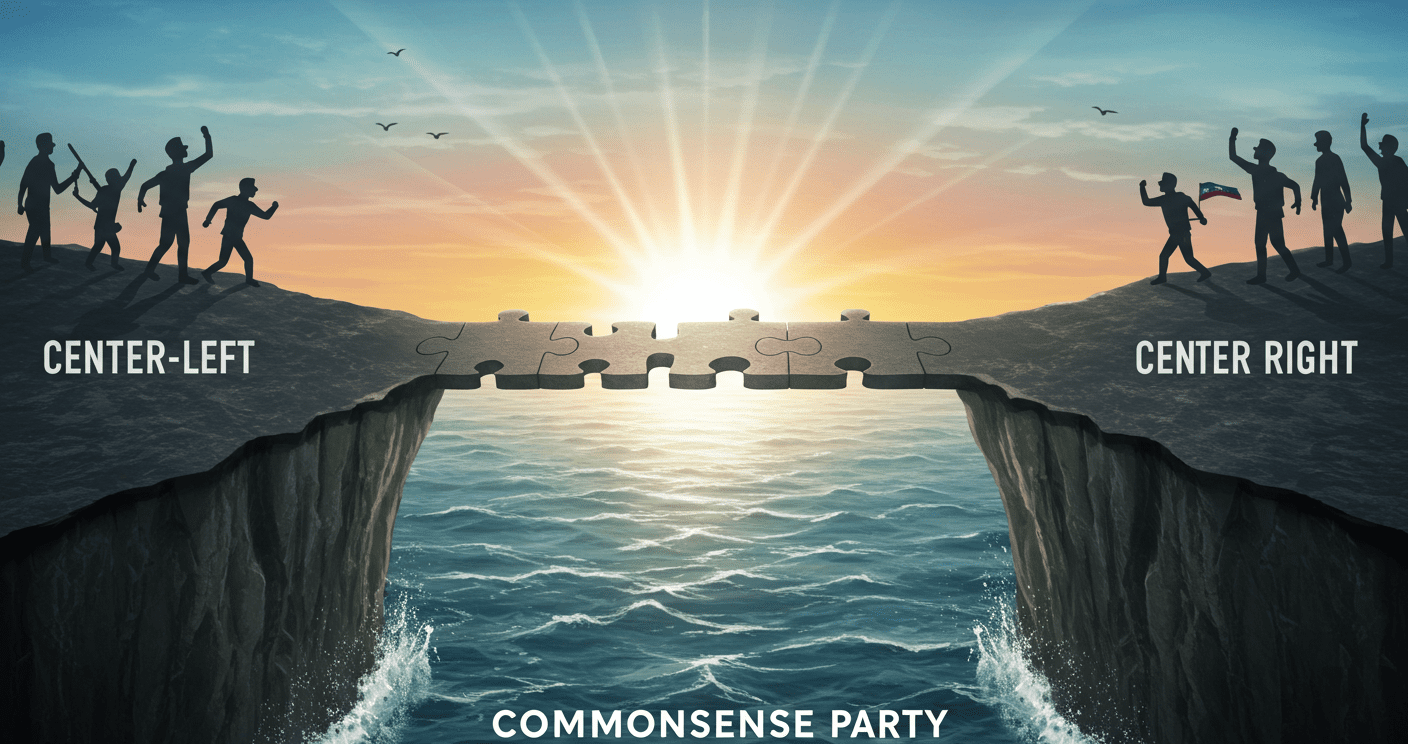
Imagine a political landscape where reason prevails over rhetoric, where collaboration trumps confrontation, and where the common good is the ultimate goal. In today’s polarized America, such a vision seems almost utopian. Yet, as the chasm between the far left and the far right widens, a compelling question emerges: What if the center-left and center-right joined forces to create a Commonsense Party?
A Shared Vision
At their core, both genuine center-right conservatives and centrist Democrats uphold fundamental principles:
Separation of Church and State: A firm belief that government should not meddle in religious affairs.
Personal Liberties: An unwavering commitment to keeping the government out of individuals’ private lives.
National Security: A dedication to collaborating with allies to defend the nation and recognizing adversaries like Vladimir Putin as threats to global stability.
These shared values lay a robust foundation for a unified political movement.
Current Collaborations: Seeds of a New Party
In the face of extremist influences, we’ve witnessed unprecedented alliances:
Principles First Summit: Recently, over 1,200 conservatives, independents, and center-left Democrats convened in Washington, D.C., to strategize against Donald Trump’s authoritarian grip on American politics. This diverse coalition underscores a collective desire to restore integrity and reason to governance.
APNEWS.COM
Bipartisan Endorsements: Prominent Republicans, including former Vice President Dick Cheney and ex-Governor Arnold Schwarzenegger, have crossed party lines to endorse Democratic candidates like Kamala Harris. Their actions highlight a prioritization of country over party loyalty.
TIME.COM
The Lincoln Project: Founded by disillusioned Republicans, this political action committee has actively campaigned against Trumpism, advocating for a return to core conservative principles and ethical governance.
EN.WIKIPEDIA.ORG
The Democratic Party’s Leadership Vacuum
While grassroots movements gain momentum, the Democratic Party’s leadership appears increasingly ineffectual:
Senate Minority Leader Chuck Schumer’s tenure has been marred by a series of missteps and perceived ineffectiveness. Additionally, House Minority Leader Hakeem Jeffries has deflected questions about the party’s declining popularity and lack of direction, offering no concrete plans to counteract Republican initiatives, further deepening the leadership void within the Democratic Party:
Mismanagement of Sensitive Communications: In January 2025, Schumer’s office inadvertently exposed the email addresses of inauguration attendees, including those of political opponents, due to a failure to use blind carbon copy (BCC) in a mass email. This blunder led to a barrage of unwanted replies and raised serious concerns about operational competence within his team.
Inadequate Response to Antisemitism: Schumer has faced criticism for his handling of antisemitic incidents, particularly on university campuses. Reports suggest he advised Columbia University officials to downplay such issues, implying that political repercussions would be minimal. This approach has been perceived as prioritizing political expediency over the safety and well-being of Jewish students.
Failure to Counteract Republican Initiatives: Under Schumer’s leadership, the Democratic Party has struggled to present a formidable opposition to the Trump administration’s aggressive policy moves. Critics argue that Schumer’s reliance on traditional political strategies has been ineffective against an administration willing to bypass established norms, leaving the party unprepared and reactive.
Lackluster Leadership: House Minority Leader Hakeem Jeffries has deflected questions about the party’s declining popularity and lack of direction, offering no concrete plans to counteract Republican initiatives.
Calls for Assertiveness: In deep-blue regions like Oakland, voters are urging Democrats to “grow a spine” and adopt a more aggressive stance against the Trump administration, expressing frustration with the party’s traditional, passive approach.
These instances underscore a broader issue within the Democratic leadership—a reluctance or inability to adapt to the rapidly evolving political landscape, thereby failing to effectively counteract the opposition’s strategies.
Building the Case for a Commonsense Party
The convergence of centrist Republicans and Democrats presents a unique opportunity:
Shared Objectives: Both factions seek to uphold democratic institutions, protect personal freedoms, and ensure national security.
Collaborative Successes: Initiatives like the Problem Solvers Caucus demonstrate the potential of bipartisan efforts to address pressing issues through cooperation and mutual respect.
EN.WIKIPEDIA.ORG
Voter Appetite for Moderation: A significant portion of the electorate is disillusioned with extreme partisanship and yearns for a political alternative that embodies pragmatism and balance.
Conclusion
The formation of a Commonsense Party, uniting center-left and center-right individuals, is not just a theoretical exercise but a practical necessity in today’s divisive climate. By focusing on shared values and collaborative governance, this new party could bridge the partisan divide and restore faith in the political system. It’s time for moderates to seize the moment and lead the charge toward a more unified and effective government.
Bipartisan Efforts Challenge Extremism in U.S. Politics




0 Comments