

Do we want people to get health care when they’re sick…
or do we want them to die more quietly and profitably (death by spreadsheet)?
Everything else is just bullshit.
Right now, as you’re reading this, more than 24 million Americans are enrolled in ACA marketplace plans, about double what it was a few years ago. That surge happened because Congress temporarily juiced the subsidies so regular people could actually afford premiums. Even MAGA voters are no longer falling for Republican crap like “tax cuts for the rich solve all your problems.”
Those enhanced subsidies are scheduled to expire. Nonpartisan analysts are warning that premiums could jump 25–30% on average in 2026, and for some people the out-of-pocket increase could more than double.
Translation: we’re about to shove millions of people back into the land of “hope you don’t get sick this year” so that a handful of ideology-drunk Republicans can brag about “cutting spending” on TV.
And that’s before we get into the states that still refuse to expand Medicaid, leaving about two million people stuck in the Medicaid coverage gap—too “rich” for their state’s broken Medicaid rules, too poor to get any real help on the exchanges. That’s what you get under Republican state governments.
So yes, the current situation is a mess. But the solution? That part is easy.
Part 1: The Policy Fix Is Not Rocket Science
If we were serious adults in a serious country, here’s what we would do this week:
1. Make the enhanced ACA subsidies permanent.
The Inflation Reduction Act quietly did something huge: it juiced the ACA premium tax credits so more people qualify and nobody has to pay more than a certain percentage of their income for premiums. That’s why enrollments hit record highs.
Letting those subsidies expire is not “fiscal responsibility.” It’s deliberate, calculated cruelty dressed up as a budget choice.
Super simple solution #1: Lock those enhanced subsidies in permanently. Make it as boring and automatic as Social Security. No yearly cliff, no last-minute hostage crisis in Congress, no voters wondering if next year’s coverage will suddenly triple in price.
2. Close the Medicaid coverage gap—by force if we have to.
Ten states still haven’t expanded Medicaid. Ten. After more than a decade. And those ten are home to the majority of people stuck in the coverage gap.
We know exactly who they are and exactly what’s happening:
- Low-income workers are stuck uninsured.
- Hospitals are quietly going broke taking on uncompensated care.
- Politicians are sending angry fundraising emails about “socialism” while their own constituents skip insulin.
Super simple solution #2:
- Carrot: Massive federal incentives for states that expand Medicaid.
- Stick: If they still refuse, create a federal fallback plan that bypasses the state and enrolls people directly, funded with the money that would have gone to that state’s Medicaid expansion anyway.
No more hostage-taking of poor people’s health so a governor can land a Fox News contract later.
3. Auto-enroll people in coverage instead of daring them to get sick.
Right now, the system is basically: “Go to this website during this narrow window, answer questions that feel like a hostile SAT test, and maybe—maybe—you’ll get subsidized coverage if you’re lucky.”
That’s insane when we already have the data to know who qualifies.
Super simple solution #3:
- Automatically enroll eligible people into zero-premium or low-premium plans during open enrollment.
- Let them opt out if they insist on rolling the dice. But default should be covered, not screwed.
We already auto-enroll people in 401(k) plans because we know defaults work. We can do the same thing for health care and save lives.
4. Put hard caps on what people can be charged out-of-pocket.
Yes, the ACA already has some protections. But with premiums rising and drug prices still ridiculous, “protection” can feel like being thrown a floatie in a hurricane.
Super simple solution #4:
- Cap out-of-pocket costs and drug prices more aggressively.
- Use the same tools we already use in Medicare drug negotiations and apply them to the marketplace.
If Big Pharma doesn’t like it, they’re welcome to try being less dependent on U.S. price-gouging to fund their stock buybacks.
None of this is exotic. None of it requires inventing new math. It’s just political will.
Which brings us to the real problem.
Part 2: The Real Endgame — Medicare for All, No Escape Hatches
Let’s be honest: fixing Obamacare’s subsidies and closing the Medicaid gap are patches on a leaky boat.
They matter. They save lives. But they still leave us with a system built around hundreds of insurance plans, endless billing codes, and a permanent fog of confusion that you’re supposed to somehow navigate while your kid is in the ER.
The straightforward version looks like this:
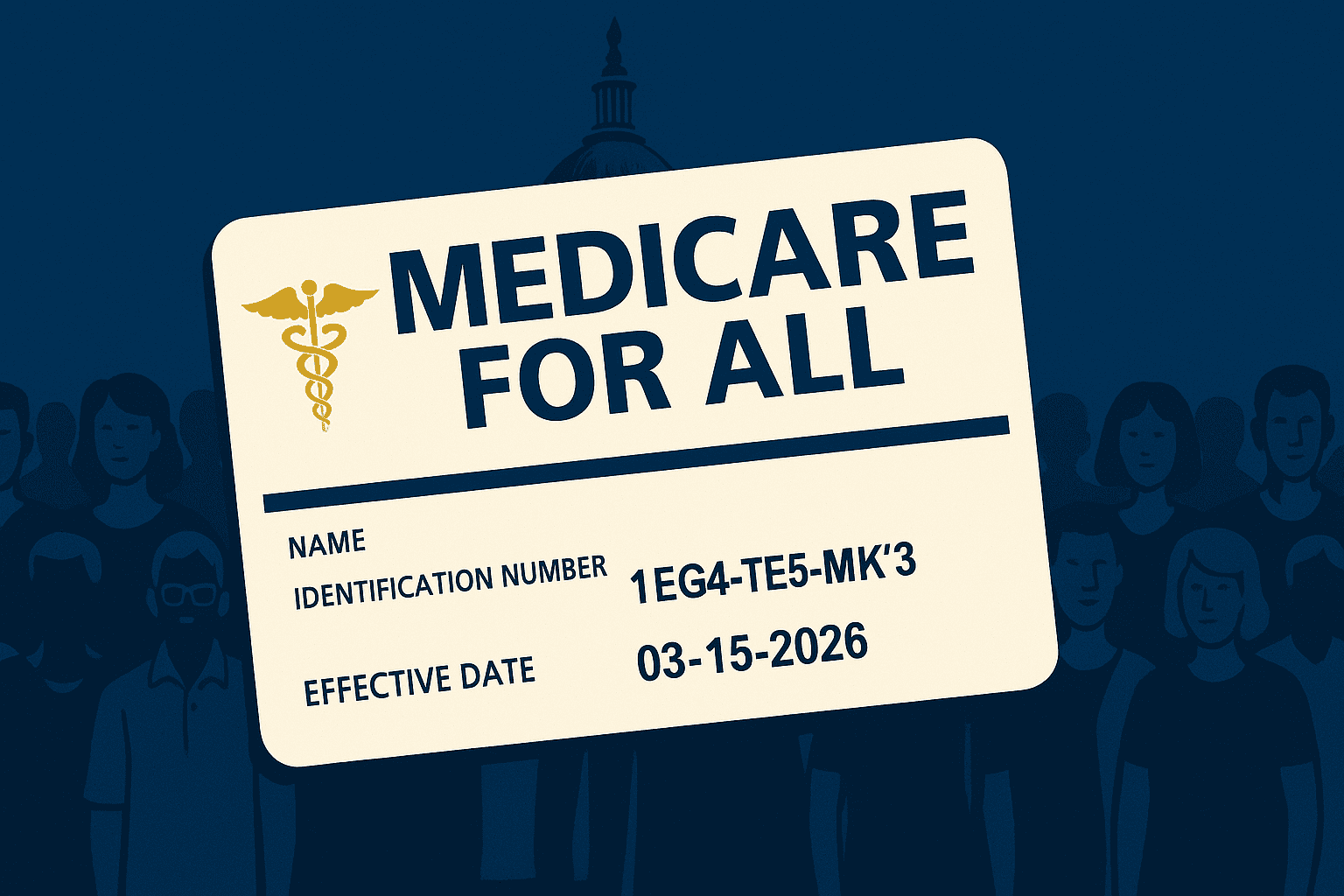
One national plan. One card. One set of rules.
Medicare for All — no exceptions, no special lanes.
Call it whatever you want: Medicare for All, single-payer, national health insurance. The basic idea is simple:
- Everyone is in the same big public risk pool.
- The national plan pays doctors and hospitals directly.
- You don’t get a stack of surprise bills because some out-of-network lab hid inside your surgery.
- Private insurance can sell extra bells and whistles, but the core coverage is the same for everyone.
And yes, that includes the folks writing the laws!
Right now, members of Congress and federal employees are tucked into their own comfy arrangements. Historically that’s been the Federal Employees Health Benefits system—big menus of plans, with the government picking up most of the tab. It’s stable, generous, and insulated from the chaos they keep unleashing on everybody else.
Your plan?
Torch the velvet rope.
- No more special federal employee gold plans on the taxpayers’ dime.
- No more clever little carve-outs for Congress and their donors.
- No more “we’re on the exchange, technically, but with a massive employer subsidy and a handpicked plan menu.”
If Medicare for All becomes the law of the land, then:
The President, members of Congress, billionaires, bartenders, retirees, and baristas all carry the same Medicare for All card.
If it’s not good enough for them, it’s not good enough for you.
So they can either fix it for all of us… or live in the mess they created.
Part 3: Why They Won’t Do the Simple Thing
So if the fixes are this straightforward, why hasn’t it happened already?
Because the current setup is working beautifully… for the people in charge.
- Insurance CEOs are doing fine.
- Hospital executives are doing fine.
- Pharmaceutical shareholders are doing very, very fine.
- Members of Congress have stable, taxpayer-subsidized coverage.
The only people getting crushed are:
- The self-employed,
- Small business owners,
- Workers in the coverage gap,
- People with chronic illnesses,
- And anyone unlucky enough to get sick in a system built to prioritize quarterly earnings over human life.
That’s not a bug. That’s the design.
Obamacare was a compromise—an improvement over the old pre-ACA chaos, plus a whole lot of political booby traps left in the wiring so it could be sabotaged later.
And we’re watching that sabotage play out right now, via expiring subsidies and manufactured shutdowns where health care becomes a bargaining chip instead of a basic service.
Part 4: Lock the Doors Behind Them — Safeguards So They Can’t Weasel Out
If you’ve watched politics for more than five minutes, you already know the game:
- Pass something popular.
- Do a big signing ceremony.
- Start quietly carving exceptions and loopholes the second the cameras leave.
So if we’re serious about Medicare for All with no special treatment, we don’t just have to pass it. We have to weld the exits shut.
Here’s what that looks like.
1. Constitutional rule: No special health care for rulers
Write it right into the freaking Constitution:
“No federal official, including members of Congress, the President, and federal judges, may receive taxpayer-funded health benefits that are more generous than those available to the general public under the national health plan.”
Period.
You want better health care than the rest of us?
Pay for it privately, on your own time, with the same rules your neighbors live under.
That doesn’t solve all the problems, but it does one big thing:
It makes it illegal to build a secret VIP escape pod after the fact.
2. Legal rule: If Medicare for All covers it, you can’t double-dip
Next, you outlaw the “shadow system.”
If Medicare for All covers hospital, doctor, and drugs, then:
- No federal employee plan can offer “different” taxpayer-funded coverage for the same thing.
- No donor-only backdoor PPO rides in on a tax subsidy.
- No congressional side-plan that “just happens” to be better in every way.
Private supplemental plans? Fine. You want a private room and a spa robe, knock yourself out.
But the basic coverage that keeps you alive and keeps you from going bankrupt is one system, one set of rules.
3. Booby traps: You cut ours, you cut yours first
Then we add the fun part: automatic tripwires.
Pass a law that says any attempt to:
- Cut covered benefits,
- Raise deductibles and co-pays for the national plan, or
- Shrink the network in ways that make care harder to get…
…must apply to members of Congress and senior officials first and cannot be delayed.
No grace period. No “phasing in.” No special exemptions.
You vote to raise everyone’s deductible by $2,000?
Congratulations, your family hits that wall on January 1, while the rest of us get a one-year warning and a national debate.
Watch how fast they suddenly “find the money.”
4. Supermajority to take away care, simple majority to make it better
Last safeguard:
- Any law that improves Medicare for All (adds benefits, reduces costs, caps drug prices) passes the way normal laws pass.
- Any law that reduces Medicare for All (cuts benefits, raises cost-sharing, shrinks eligibility) must:
- Clear a two-thirds majority in both chambers, and
- Be approved in a national referendum.
If you’re going to take away people’s health care, you should have to do it out in the open, with the whole country watching—and agreeing.
Good luck selling “vote yes to pay more and get less” to the voters.
Part 5: What the No Wimps Army “Wolverines” Can Actually Do
Okay, so what do we do with this?
You’re not the head of CMS. You’re not writing the federal budget. You’re one voter trying to survive a system that’s already too damn stressful.
Here’s how to translate simple solutions into simple actions:
1. Know the stakes, not just the slogans.
When you hear “sunsetting ACA subsidies,” translate that to:
“We are intentionally making health care more expensive for millions so we can give tax cuts to people who already have private jets.”
2. Hammer your representatives on three concrete demands.
- Make enhanced ACA subsidies permanent.
- Close the Medicaid coverage gap with a federal fallback.
- Auto-enroll eligible people into coverage by default.
One email or phone call that says that, clearly, is worth more than a dozen vague “Please protect health care” messages.
3. Refuse to vote for anyone who treats health care as a bargaining chip.
If a candidate is willing to shut down the government, or let subsidies expire, or keep the Medicaid gap open in your state, they are telling you—out loud—that your life and your neighbors’ lives are negotiable.
Believe them.
4. Back candidates who run on boring, concrete fixes.
Not vibes. Not slogans. Not “repeal and replace” with no actual “replace.”
Back people who say things like, “We’re going to make these subsidies permanent, close the gap, and auto-enroll people. Here’s the bill number.”
5. Keep receipts and share stories.
If your premiums skyrocket, if you have to drop coverage, if you’re in the gap—document it. Tell your story. That’s ammo for the rest of the Wolverines who are still being told everything is “too complicated” to fix.
The Bottom Line
Fixing Obamacare isn’t a twelve-dimensional chess problem.
It’s a yes-or-no question:
- Yes, we want people to get care without going bankrupt, so we’ll lock in subsidies, close the gaps, and default to coverage.
- Or no, we’re fine sacrificing millions of people’s health so a small group of politicians and donors can keep pretending “the market” is solving everything.
In other words:
- Short term: lock in ACA subsidies, close the Medicaid gap, auto-enroll people.
- Long term: demand Medicare for All with no escape hatches, and only back candidates who are willing to live under the same system they vote on.
The policy fixes are straightforward.
The political fix is even simpler:
Make the people who break the system live inside the system.
Until that happens, the No Wimps Army “Wolverines” have one job:
Remember who chose the complicated suffering over the simple solution—
and make sure they don’t get another chance to do it.




0 Comments