
Part One: From Beer Hall Nobodies to National Juggernaut
Most people think Adolf Hitler showed up fully formed, ranted a bit, and boom — Nazi Germany was born. Not even close. In the beginning, Hitler wasn’t even the leader. He was just some angry veteran hanging out in post-World War I Germany, where the economy was crumbling and the people were desperate for someone — anyone — to blame. He found his way to a scrappy little political group called the Deutsche Arbeiterpartei — the German Workers’ Party, or DAP. Now, the DAP was tiny. Like, hold-your-meetings-in-a-beer-hall tiny. But what they lacked in size, they made up for in sheer rage. They hated Communists, they hated capitalists, they hated Jews, and they really hated the Treaty of Versailles, which had Germany paying out the nose for losing the war. Problem was, all that hate didn’t come with a marketing plan. They were just one more angry fringe group in a country full of them. That’s where Hitler came in. The guy understood something crucial — rage is a product, and if you package it right, you can sell it to the masses.
Part Two: The Power of a Name (and a Makeover)
The German Workers’ Party sounded… boring. It had no spark. So, in 1920, they slapped on a new, supercharged label: Nationalsozialistische Deutsche Arbeiterpartei — the National Socialist German Workers’ Party, or NSDAP. Let’s break down why that was marketing gold.
- “National” hit the patriotic, flag-waving crowd — the folks who thought Germany had been stabbed in the back by traitors and foreigners.
- “Socialist” dangled a lure for working-class Germans struggling in the economic chaos — promising them a better deal, higher wages, and pride in their labor.
- “German Workers’ Party” kept the blue-collar vibe, appealing to the little guy who felt ignored and screwed over.
It was the political equivalent of selling a truck by saying it’s tough enough for hard work, patriotic enough for your flag bumper sticker, and still cares about giving you a fair shake. Even though the party itself was violently anti-Communist and cared about workers only as long as they were German, Christian, and obedient — the branding was everything. Hitler and his pals also mastered simple messaging. They boiled every problem down to “Germany First” and “It’s Their Fault.” Whether it was the Jews, Communists, or the “weak” politicians who signed the Treaty of Versailles, the message was always the same: We were great. They betrayed us. Join us and we’ll make Germany strong again. Sound familiar? Hold that thought.
Part Three: From Hitler to Trump — The Echoes of Populist Branding
Now, I’m not saying Trump is Hitler. That’s lazy and inaccurate. But I am saying Trump’s strategy of branding, simplifying, and weaponizing grievances — yeah, that’s straight out of the NSDAP marketing playbook. Let’s compare.
-
Rebranding for Maximum Punch
Just like the DAP became the NSDAP, Trump didn’t run as a boring old Republican — he ran as the head of the Make America Great Again movement. That’s a brand, not just a slogan. It’s a promise, a vibe, and a call to arms all in four words. Just like “National Socialist German Workers’ Party” wasn’t about socialism, MAGA isn’t about traditional conservatism — it’s about America First, them vs. us, and “take back what they stole from you.”
-
Rage as a Product
Hitler sold Germans on the idea that their suffering wasn’t random — it was caused by enemies (Jews, Communists, intellectuals, etc.). Trump’s been selling Americans a similar story: Your jobs? Stolen by immigrants. Your culture? Destroyed by “woke” elites. Your country? Betrayed by rigged elections, deep state operatives, and globalists. It’s the same formula — simplify complex problems into a good guy/bad guy story, and sell yourself as the only one brave enough to fight.
-
The Hero Cult
Hitler wasn’t just a politician; he was the savior of Germany. His image was plastered everywhere, from stamps to schoolbooks. Trump’s face, name, and brand are equally inescapable — from golden sneakers to flag-draped merch, Trump is the movement. Like Hitler, he’s positioned himself not just as a leader but as a symbol — attack him, and you’re attacking his followers too.
-
Create the “Stab in the Back” Myth
Germany didn’t lose WWI on the battlefield, Hitler claimed — it was betrayed from within. Sound like the 2020 election narrative? Trump didn’t lose, he says — he was stabbed in the back by rigged systems, fake news, and disloyal insiders. Same story, different country.
-
The Power of Spectacle
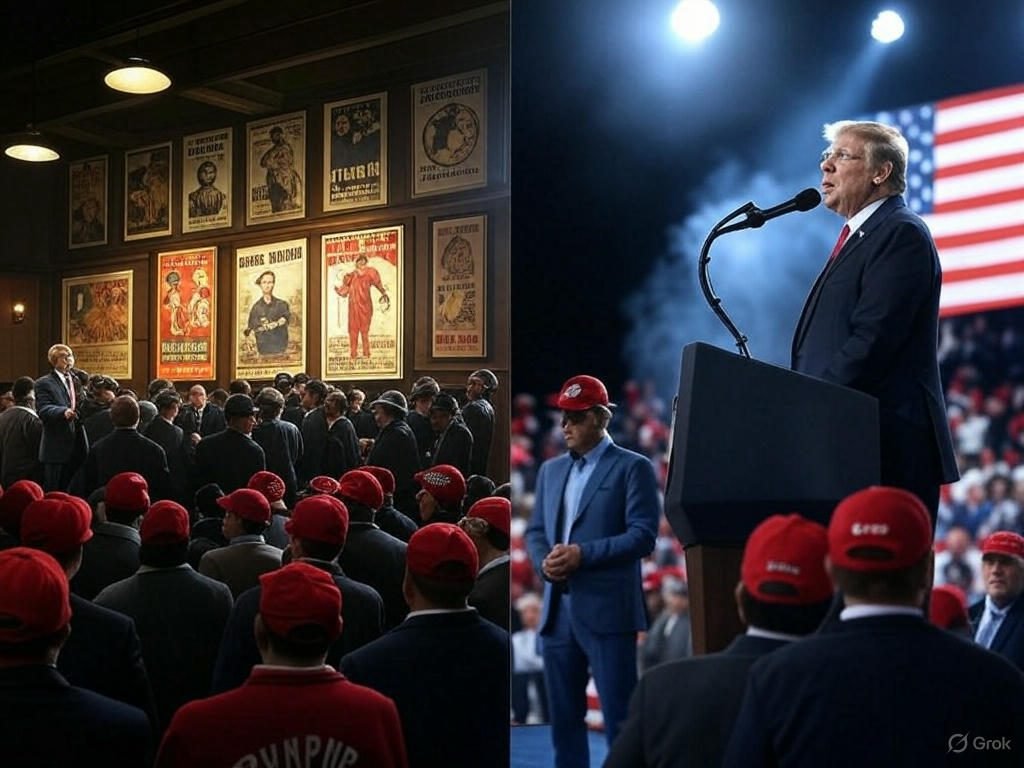
The Nazis knew how to put on a show — torchlit rallies, dramatic symbols, choreographed salutes. Trump rallies, with their flags, chants, and stagecraft, pull from that same spectacle-driven politics. It’s not just a campaign event — it’s a movement gathering.
Why This Matters
Now, none of this means Trump’s going to invade Poland or build death camps. That’s not the point. The point is that the methods used to sell extreme populism and turn anger into power haven’t changed much in a hundred years. It’s marketing psychology, plain and simple — and history shows us how dangerous it can get if nobody hits the brakes. The Nazis weren’t just monsters — they were master marketers. They took a fringe party and, through branding, simplification, and relentless scapegoating, built a machine that took over one of the most advanced nations on Earth. Trump’s tapping into that same vein — not because he’s a student of history, but because these tactics work. They always work, especially in tough economic times when people are desperate for someone to blame. History doesn’t repeat itself, but it sure as hell rhymes — and if we don’t recognize the tune, we’re liable to dance to it all over again.
Conclusion
The lesson from history couldn’t be clearer — when authoritarians start rebranding their movement to make it more palatable to the masses, the real danger isn’t just their rise to power. It’s what comes next. Once they’ve secured a foothold, they move to consolidate power, eliminate opposition, and rewrite reality itself. It’s not a guess — it’s a proven playbook.
That’s why Americans who still believe in democracy must defend the Constitution, even when — especially when — the threat comes from within. History shows us exactly how this story unfolds, and Trump’s Nazi consolidation tactics are already well underway.
The only real question is whether we’ve learned enough from history to stop it this time — or if we’re about to find out what it’s like to lose a democracy from the inside.


0 Comments