
The nation-state can’t stop borderless threats. A limited, democratic world federation can.
The nation-state had a good run. It gave people flags, borders, armies, tariffs, passports, and an endless supply of politicians who puffed out their chests and swore they alone could keep the barbarians at the gate. Cute story. Shame about reality.
Because reality says this: the biggest threats on Earth do not stop at borders, do not care about national myths, and do not politely wait for 193 governments to agree on a memo. War spreads. Cybercrime spreads. Pandemics spread. Climate damage spreads. Dirty money spreads. Human trafficking spreads. Nuclear risk hangs over everybody, whether they voted for it or not. And the system we still treat as sacred national sovereignty is structurally built to handle those threats badly, slowly, or not at all.
That is the part many people still refuse to face: this is not just a leadership problem. Yes, bad leaders make everything worse. Yes, men drunk on power can turn entire populations into hostages. But even when better people are in charge, the machinery itself is broken. The current international order can coordinate, bargain, plead, and posture. What it usually cannot do is compel uniform enforcement across borders. And when enforcement is optional, predators thrive.
That is why I am not arguing for some cartoon “one world government” with a giant boot stamping on humanity from a marble tower on the moon. I am arguing for something both tougher and saner: a limited world federation. A constitutional, rights-protected, multi-level system in which local matters stay local, national matters stay national, and only genuinely global threats are handled at the global level.
The real scandal: borders now protect predators as often as they protect freedom
Cartels love borders. Human traffickers love borders. Money launderers love borders. Cybercriminals love borders. They love them because every border is also a seam in the law, a crack in enforcement, a place to hide evidence, shift assets, exploit corruption, or hop to a friendlier jurisdiction. The modern transnational criminal economy is basically a parasite that feeds on fragmented sovereignty.
Same story with climate. Same story with pandemics. Same story with cybercrime. Everyone signs frameworks, accords, declarations, and lovely documents full of worthy verbs. Then enforcement hits the same brick wall: sovereign states can defect, stall, reinterpret, underfund, veto, or simply ignore the agreement when it becomes inconvenient. That is not a bug in the system. That is the system.
If you want one sentence that explains why the world keeps lurching from crisis to crisis, here it is: our problems are global, but our enforcement is not.
The United Nations is not a world federation
Let’s clear something up before the usual suspects start hyperventilating: the United Nations is not a world government. It does not have sovereign legislative authority over humanity. It does not have universal criminal jurisdiction. It does not have a standing army or police force of its own.
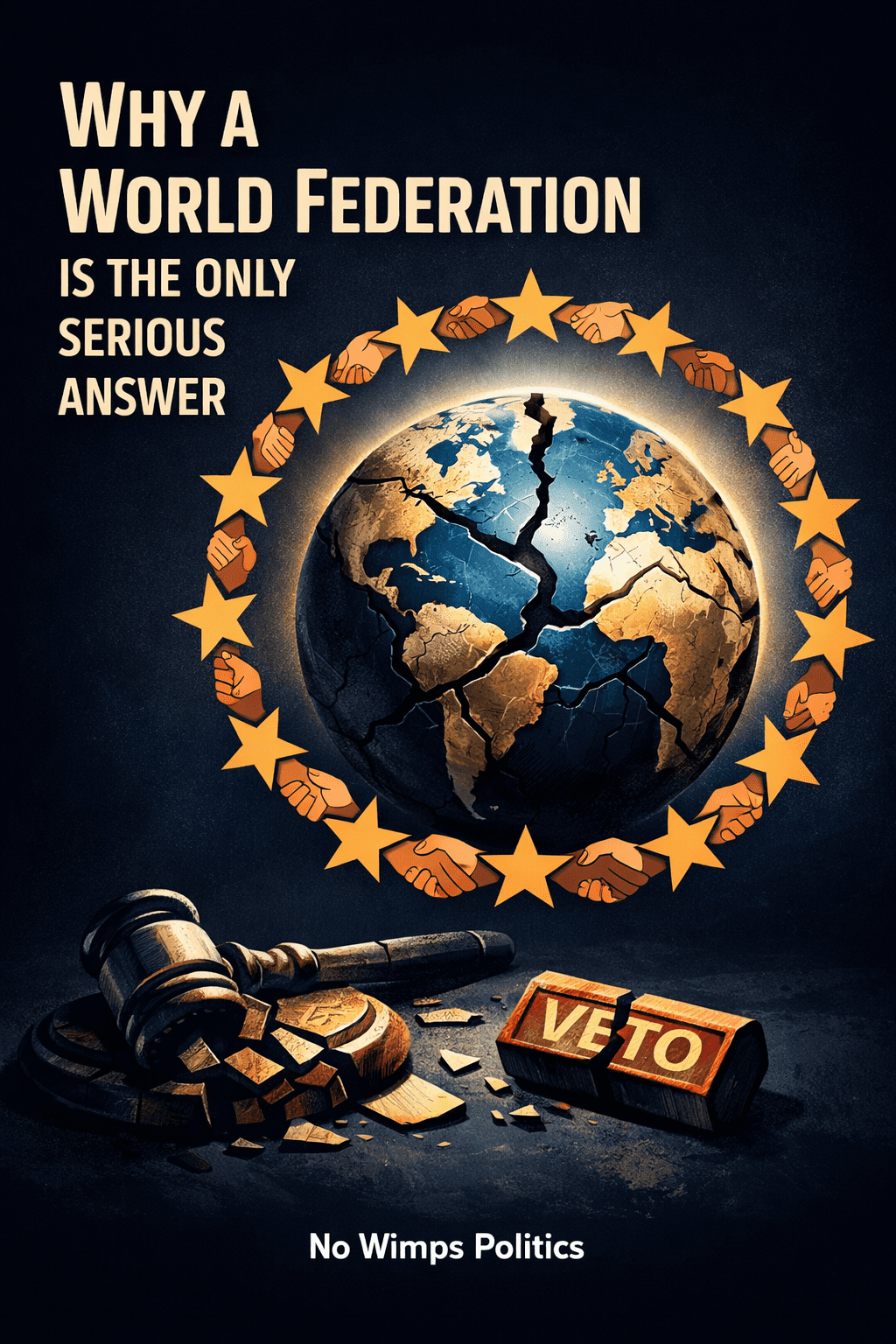
Worse, the UN was structurally hobbled at birth by the Security Council veto. If one of the major powers or its core interests is involved, the system can freeze right when you need it most. That was understandable in 1945. It is a disaster in 2026.
So when critics point at the UN and say, “See? Global governance doesn’t work,” they are accidentally proving the opposite point. What they are really showing is that a non-sovereign global body with no standing enforcement arm and a great-power veto cannot reliably protect humanity from war, transnational crime, or global collapse.
World federation is not code for global dictatorship
Now comes the honest objection, and it is not stupid. Plenty of sane people hear “world government” and think: wonderful, one tyrant to rule them all. One planetary despotism. One colossal failure point. One global civil war if things go wrong.
That fear is real. That is why the answer cannot be “give some distant elite unlimited planetary power and hope for the best.” The answer has to be federalism, subsidiarity, constitutional rights, separation of powers, and democratic accountability.
Give the global level only those powers needed to handle global problems: war prevention, WMD control, core transnational crime, climate enforcement, pandemic response, cyber evidence and cybercrime standards, and the defense of baseline human rights. Leave ordinary domestic life where it belongs: close to the people living it.
So no, this is not a plea for one giant capital bossing every town on Earth. It is a plea for lawful civilization at the level where our gravest dangers already operate.
The path forward is not fantasy
We are not starting from a blank sheet of paper. We already live in a world full of partial experiments in pooled sovereignty, supranational law, and transnational governance. The European Union is not a world federation, but it is proof that states can bind themselves to higher law without ceasing to exist. The International Criminal Court is not a global police force, but it is proof that at least some crimes are too large to be shrugged off as “internal matters.” The problem is not that humanity has never taken a step in this direction. The problem is that we keep stopping halfway.
There is also a live movement infrastructure for people who want to push further. Citizens for Global Solutions, founded in 1947 as the United World Federalists, openly carries forward a vision of a peaceful, just, and sustainable world community democratically governed through a united federation of nations.
At the international level, the World Federalist Movement–Institute for Global Policy pushes for more effective, transparent, and accountable global governance leading to democratic world federation.
There is also a practical reform track already underway. The Campaign for a UN Parliamentary Assembly is one of the smartest incremental steps on the board. The allied We The Peoples campaign pushes concrete reforms for more inclusive and accountable global governance.
And if you want a path built into the UN Charter itself, there is Article 109. The Article 109 Coalition exists to mobilize support for a General Conference to review and update the UN Charter.
What this movement needs in America
What the United States does not need is one more salon conversation where well-read people sip coffee, nod gravely about global governance, and then wander off to do nothing. We have enough of those to wallpaper the moon.
What we need is a movement. A real one. Something with urgency, local entry points, and moral clarity. We need a version of that energy for world federalism. Not a cult. Not a think-tank-only club. A recruiting engine. A public education engine. A “here’s where you plug in this week” engine.
That means stop treating world federation as a graduate seminar topic and start treating it like what it actually is: the unfinished democratic project of human civilization.
Here is how to get the ball rolling
First: stop using the phrase in a way that scares people for free. Lead with world federation, not “global authority.” Explain federalism. Explain subsidiarity. Explain that the point is not to erase nations or bulldoze local culture. The point is to put genuinely global threats under genuinely lawful democratic control.
Second: join or support groups already in the fight. In the U.S., that means Citizens for Global Solutions first. If you are in Minnesota, there is already a Minneapolis–Saint Paul chapter. If there is no chapter near you, the organization explains how to start one.
Third: back reforms that build democratic global machinery step by step. Support a UN Parliamentary Assembly. Support the We The Peoples platform. Support Article 109 Charter review.
Fourth: organize locally. Host reading groups. Public talks. Zoom salons that turn into working groups. Campus chapters. Meetup circles. Constitutional workshops. Build a movement front end that channels people toward the organizations already doing the heavy lifting.
Fifth: stop pretending this can wait. Nuclear arsenals still exist. Climate enforcement is still weak. Cybercrime is still border-hopping. Traffickers and cartels are still exploiting legal seams. The old system is not mostly fine. It is increasingly a global liability.
Get involved
- Citizens for Global Solutions
- Citizens for Global Solutions Minnesota
- Start a CGS Chapter
- World Federalist Movement–Institute for Global Policy
- Campaign for a UN Parliamentary Assembly
- We The Peoples
- Article 109 Coalition
Ready to stop doomscrolling and start building? Start by learning the case for democratic world federation. Then connect with people already doing the work. Look up Citizens for Global Solutions, the Minneapolis–Saint Paul chapter, the Campaign for a UN Parliamentary Assembly, We The Peoples, and the Article 109 Coalition. The future will not organize itself.


0 Comments