

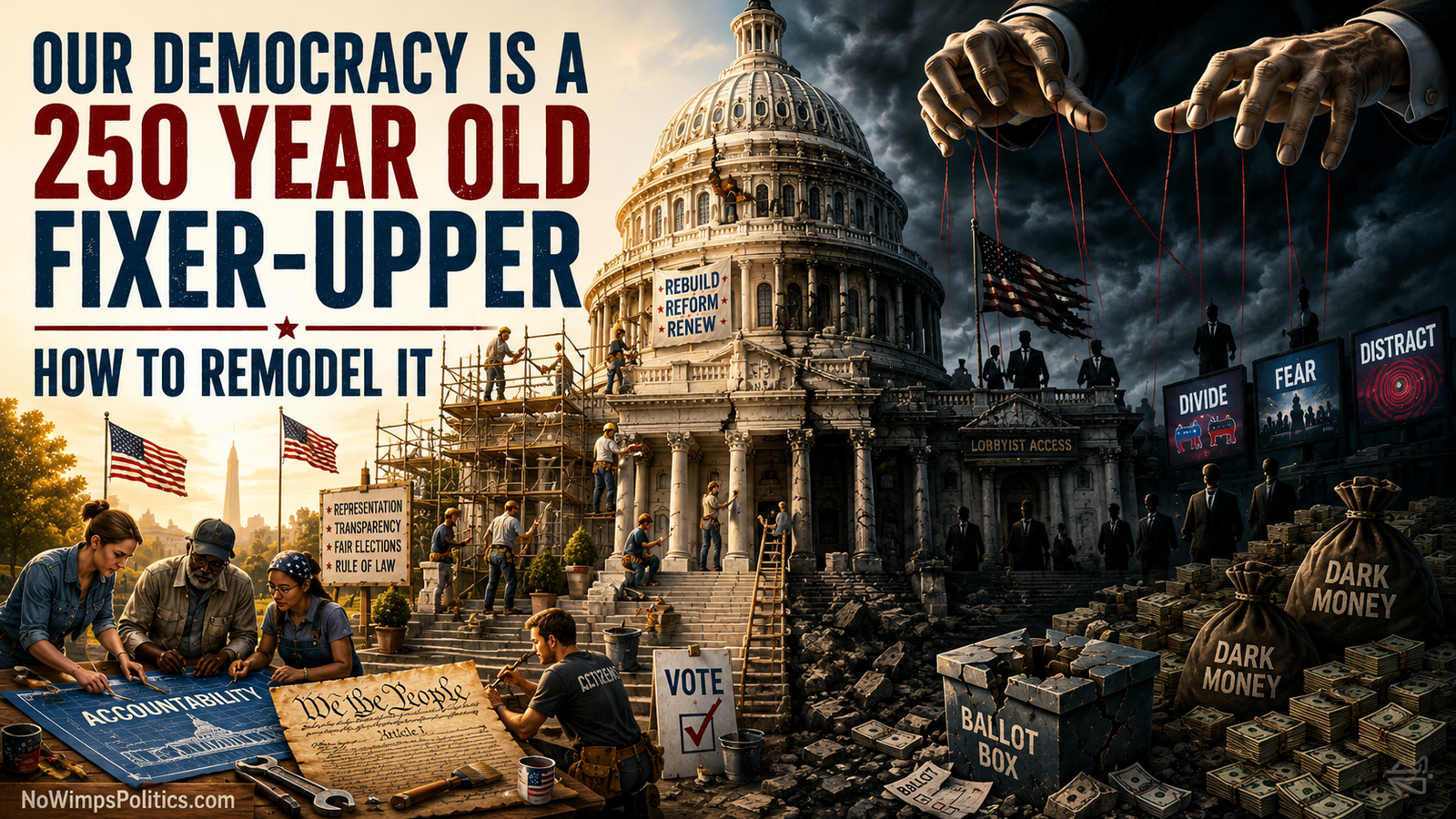
Our Democracy is a 250 Year Old Fixer-Upper – How To Remodel It
America’s democracy was designed nearly 250 years ago for a completely different world. The system still contains brilliant ideas, but it also contains dangerous weaknesses: weak accountability, too much money in politics, outdated representation, and almost no meaningful qualifications for the most powerful offices in the country. If democracy is going to survive modern corruption, propaganda, billionaire influence, and authoritarian movements, it needs more than nostalgia. It needs repair.
Key Takeaways
- America’s democracy was designed for a world that no longer exists.
- The Constitution was a starting point, not a finished machine.
- Money, corruption, weak accountability, and outdated representation have warped the system.
- Democracy needs automatic accountability, not polite requests for shame.
- Real reform means campaign finance reform, ranked-choice voting, independent redistricting, anti-corruption enforcement, and regular democratic maintenance.
- Democracy is not dead, but it is neglected — and neglected systems eventually fail.
So, let me start with a few statements that I believe are foundational. And I promise you won’t like them:
- Every civilization rests on a bed of barbarians who don’t understand civilization and wouldn’t like it if they did. That’s MAGA.
- Power corrupts. And absolute power corrupts absolutely. – That’s every politician.
- They may start out with principles, but the constant deal-making required in Washington to accomplish anything, the constant need for money to run a winning campaign, and the requirement to make deals with the devil to get that money, creates the realization that the only thing of value in Washington is power.
- And let’s stop being naive: People are not equal and never have been. Don’t believe me? How many billionaires have invited you over for dinner? How many homeless people have you invited over for dinner? So let’s stop with the “equal” nonsense.
- All complex systems eventually fail. Governments, corporations, economies, religions, even families. They don’t usually break all at once. Instead, lots of little problems slowly build up and don’t get fixed, until one day everything falls apart. That’s entropy and chaos. And all this means is that chaos and entropy are kissing cousins and they often work together to trash any system.
- Lastly, all humans are fallible. Period.
Now that we’ve established a few ground rules, let’s discuss our horribly naive democratic system that is crumbling around us.
While no system will ever make everyone equal, let’s see what we can do to build a system that will keep those of us in the low power realm from getting stomped on by the rich and powerful.
I believe that was what “government” was initially created to do.
It’s abominable that some rich asshole (Trump) with a billion dollars should be able to rally all his rich buddies together behind our backs, promise them absolute power if he wins, and then buy his way into the White House.
Why did this happen? Because there is no accountability built into the system.
The idea that any idiot can run for office (see: “rich asshole”) is laughable. When you apply for a job, and I mean any job, you have to show them that you are qualified for that job.
You must either have a history of working in the industry with accomplishments to show for it and a list of references, or at the very least, show that you can understand directions and follow them.
If you want to run for office, you don’t have to do any of that.
If you buy enough TV time and tell everyone, “If you vote for me, I’ll give you free stuff and kiss your ass,” you’re a shoo-in.
Don’t believe me, listen to Trump’s speeches when he was running for office.
That is not a qualification to represent large numbers of people. And yet, that’s how the current president of the United States, the most powerful position in the world, with a nuclear arsenal he can launch on a whim, got into office.
In what insanely screwed up world does that make any sense? You need more qualifications to clean up poop in a dog park than you are required to have to be president.
And that is where the system begins to fail.
Not because democracy is a bad idea.
Democracy is a magnificent idea.
It says that government should not be the private hunting preserve of kings, priests, billionaires, warlords, or whatever overfunded goblin currently owns the most television stations. It says the people who live under the rules should have some say in who writes the rules.
It says power should come from consent, not bloodline, not divine appointment, not daddy’s money, and not whichever loudmouth can rent the biggest airplane and scream the loudest at a rally.
That part is beautiful.
The problem is that we built the American version of democracy with 18th-century assumptions, 19th-century machinery, 20th-century bureaucracy, and 21st-century corruption.
Then we acted shocked when the engine started coughing smoke.
The Founders were not stupid men. Some were brilliant. Some were brave. Some were hypocrites. Some owned human beings while writing poetry about liberty, which is a pretty good early warning sign that “brilliant” and “morally reliable” are not the same thing.
But they were designing a system for a world of horses, handwritten letters, local newspapers, slow travel, limited voting rights, and political elites who mostly knew each other personally.
They were not designing for cable news rage machines, billionaire-funded propaganda networks, AI-generated lies, social media mobs, multinational corporations, nuclear weapons, private data empires, and a population trained to treat politics like professional wrestling with subpoenas.
So no, the Constitution did not “fail” because the Founders were idiots.
It failed because every system fails when it refuses maintenance.
And America has treated democracy like a sacred antique chair in the corner of the room.
We worship it.
We quote it.
We drape flags over it.
We hold ceremonies around it.
But heaven forbid we actually fix the wobbly leg before the whole thing dumps grandma into the punch bowl.
Essentially, the Republicans are ignoring the Constitution and the Democrats are playing by 250 year old rules. They both need a swift kick in the ass.
The Founders Built a Skeleton, Not a Finished Machine
The Constitution is not magic parchment.
It is a design document.
And like any design document, it reflects the fears, knowledge, blind spots, and compromises of the people who wrote it.
The Founders feared monarchy, so they divided power.
Good.
They feared mob rule, so they filtered democracy through institutions.
Understandable, although not always noble.
They feared concentrated power, so they created checks and balances based on self-interest.
Excellent idea.
But they did not solve the problem of what happens when one political movement decides checks and balances are only useful when they check the other side.
They did not solve what happens when wealthy interests can capture both parties.
They did not solve what happens when voters are buried under professional-grade deception.
They did not solve what happens when Congress becomes a retirement home for ambition, lobbyists become the real legislative staff, and the Supreme Court starts behaving like nine unelected philosopher-kings in expensive robes.
And they certainly did not solve what happens when a candidate can turn ignorance into a brand, cruelty into entertainment, corruption into loyalty testing, and shamelessness into political armor.
That is not a normal candidate.
That is a system exploit.
Trump did not invent America’s weaknesses.
He found them.
He found the unlocked windows, the rotten beams, the blind spots in the cameras, and the guards asleep at the desk. Then he invited the rest of the burglars in and told them to take whatever wasn’t nailed down.
And the terrifying thing is not just that he did it.
The terrifying thing is how easy the system made it.
“Let the Voters Decide” Is Not Enough
Whenever someone suggests higher standards for office, someone immediately cries, “But the voters should decide!”
Yes.
The voters should decide.
But voters can only make meaningful decisions inside a system designed to give them real choices, real information, real accountability, and real consequences.
Right now, we do not have that.
We have campaigns.
Campaigns are not job interviews. Campaigns are marketing blitzes. Campaigns are theatrical combat. Campaigns are fundraising machines stapled to personality cults and focus-grouped slogans.
A modern campaign does not ask, “Who is qualified to govern?”
It asks, “Who can dominate attention?”
Those are wildly different questions.
A person can be entertaining and incompetent.
A person can be famous and dangerous.
A person can be rich and stupid.
A person can be charismatic and morally bankrupt.
A person can win an election and still be catastrophically unfit for power.
That last sentence should not be controversial. It should be printed over the entrance to every polling place in America.
Because democracy does not mean every candidate is equally qualified.
Democracy means the people have the right to choose their leaders.
But a healthy democracy also has the duty to protect the people from fraud, corruption, coercion, deception, and anti-democratic sabotage.
We already understand this everywhere else.
You cannot practice medicine because you have strong opinions about spleens.
You cannot fly a commercial airliner because people like your hat.
You cannot become a police officer without background checks, training, standards, and review.
You cannot teach kindergarten without proving you are not a danger to the children.
But you can run for the presidency of the United States with almost no evidence that you understand government, respect the Constitution, can manage complex institutions, tell the truth under pressure, or keep your ego away from the nuclear codes.
That is not democracy.
That is negligence wearing a flag pin.
The First Fix: Real Qualifications for Real Power
Here is where people get nervous.
“Are you saying some committee should decide who is allowed to run?”
No.
I am saying the most powerful offices in the country should have basic, public, nonpartisan qualification standards.
Not ideological standards.
Not “only my side gets to run” standards.
Not some sneaky elite filter where a bunch of cocktail-party parasites decide who is respectable enough to be president.
I mean basic standards of fitness for power.
For example:
A candidate for president, vice president, Congress, federal judge, and cabinet-level office should have to pass a public constitutional literacy examination.
Not a partisan quiz.
Not “what is your opinion on tax policy?”
A real civics and constitutional duty exam.
What powers does the office have?
What powers does it not have?
What rights can government not violate?
What is the role of Congress?
What is the role of the courts?
What is the chain of command?
What is impeachment?
What is due process?
What is the peaceful transfer of power?
What is an oath?
And here is the killer: the candidate’s answers should be public.
Not pass-fail in a dark room.
Public.
Let the voters see whether the person asking for power understands the job.
Second, candidates should be required to disclose full financial conflicts of interest.
Not just vague forms written by lawyers who specialize in hiding elephants under cocktail napkins.
- Full conflicts.
- Debts.
- Major assets.
- Foreign entanglements.
- Business partnerships.
- Major donors.
- Family business conflicts.
- Pending cases.
Any relationship that could cause the public to ask, “Is this person serving us, or are they serving the people who own their leash?”
Third, candidates should be required to release tax returns for a meaningful number of years.
Again, this is not complicated.
A president has power over taxation, regulation, federal contracts, foreign policy, law enforcement, and the economy. If that president has secret financial dependencies, the public has a right to know.
Fourth, serious candidates should be required to participate in structured public interviews conducted by a nonpartisan civic panel.
Not debates. Debates are theater. Debates reward zingers, bullying, and the ability to lie confidently while wearing stage makeup.
I mean interviews.
Long-form.
Detailed.
Boring, if necessary.
Government is often boring. That is not a flaw. That is a safety feature.
Let candidates explain how they would handle emergencies, conflicts of interest, military decisions, economic shocks, constitutional limits, agency appointments, and corruption inside their own administration.
The person applying to manage the most powerful government on Earth should be able to survive a three-hour job interview without melting into pudding.
The Second Fix: Money Must Stop Being a Crowbar
The next failure is money.
Money has become the crowbar used to pry democracy open.
We pretend every citizen has one vote. Technically, yes.
But influence is not distributed by vote count.
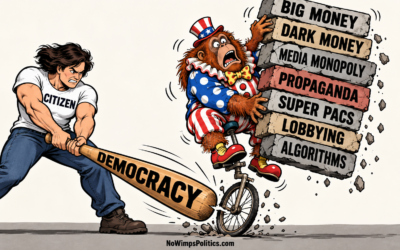
Influence is distributed by access, donation networks, lobbying power, ownership, media reach, legal muscle, and the ability to keep politicians terrified of the next primary.
A billionaire does not need more votes than you.
A billionaire just needs more microphones.
More lobbyists.
More lawyers.
More PACs.
More “independent” groups that are independent in the same way a mob boss’s cousin is “not officially involved.”
We need to stop pretending this is normal.
Campaigns should be publicly financed.
Small donations should be matched aggressively.
Dark money should be dragged into sunlight and made to squirm.
Every major political ad should clearly disclose who paid for it (the individuals, not the phony organization with the impressive name), who benefits from it, and whether the message is connected to a candidate, party, corporation, union, billionaire, nonprofit shell game, or political action committee wearing a fake mustache.
And no, money is not speech.
Speech is speech.
Money is amplification.
A person shaking hands in the town square and a billionaire buying every billboard, radio station, mailbox, algorithm, and television ad in the state are not exercising equal speech.
One is speaking.
The other is buying an election.
The Third Fix: Representation Must Actually Represent
Our current system does not represent the country very well.
The Senate gives enormous power to land over people.
The House is capped too small for the population.
Gerrymandering lets politicians choose their voters instead of voters choosing their politicians.
The Electoral College can override the national popular vote.
Primary elections reward the angriest, most ideological, most reliable voters, which means politicians often fear their own base more than they respect the country.
That is not healthy representation.
That is a machine designed to produce grotesque, reality-warping distortions so extreme they bend representation into a funhouse mirror of democracy itself.
We need independent redistricting everywhere.
We need ranked-choice voting so people can vote honestly without feeling like they are throwing their vote into a wood chipper.
Ranked-choice voting means voters rank candidates in order of preference instead of picking only one.
First choice.
Second choice.
Third choice.
And so on.
If no candidate wins a majority of first-choice votes, the candidate with the fewest votes is eliminated. The people who voted for that candidate then have their votes transferred to their next choice. The process repeats until someone has a majority.
In plain English: your vote is not “wasted” just because your favorite candidate loses.
That matters because our current winner-take-all system pressures people to vote strategically instead of honestly. People end up voting against the candidate they fear rather than for the candidate they actually support.
Ranked-choice voting reduces the “spoiler effect,” gives independent and third-party candidates a fairer shot, and rewards candidates who can appeal beyond their most rabid supporters.
It encourages coalition-building instead of permanent blood-feud politics.
And perhaps most importantly, it makes elections feel less like hostage negotiations.
We need a larger House of Representatives so one representative is not trying to represent a small nation’s worth of people.
We need serious discussion of proportional representation so political minorities and majorities are both represented more accurately.
And yes, we need to deal with the Electoral College.
The presidency should not be a casino game where a few swing states get treated like royalty while everyone else gets campaign leftovers and patriotic confetti.
One person. One vote. Highest total wins.
That is not radical.
That is how children assume elections work before adults explain the antique plumbing.
The Fourth Fix: Accountability Must Be Automatic
Here is one of the biggest problems with American government:
The system relies too much on shame.
But shame only works on people who still have some.
Once shameless people learn that norms are not laws, the whole system becomes a buffet. And at this point, the modern Republican Party has practically turned “no shame” into a governing philosophy.
Don’t release your tax returns?
No real consequence.
Lie constantly?
No real consequence.
Profit from office?
Maybe someone will investigate, someday, if the committee has funding, courage, subpoena power, and a calendar that isn’t already on fire.
Defy Congress?
Delay.
Appeal.
Stonewall.
Run out the clock.
Pardon your friends?
Shrug.
Threaten public servants?
Fundraise off it.
Try to overthrow an election?
Call it patriotism and sell hats, Bibles, and political influence.
This is madness.
A modern democracy cannot depend on honorable behavior from people who have discovered that dishonor pays.
We need automatic accountability.
If a candidate refuses required financial disclosure, they do not appear on the ballot.
If an officeholder uses public office for private profit, an independent anti-corruption office automatically investigates.
If an official defies lawful oversight, funding and enforcement consequences trigger automatically.
If judges accept gifts, trips, money, or favors from interested parties, disclosure and recusal rules must be mandatory and enforceable. And “enforceable” cannot mean “strongly worded disappointment from another committee.” That has been one of the biggest failures in the entire federal system. Rules without independent enforcement are decorations.
Right now, most federal enforcement power ultimately runs through the Department of Justice, which answers to the executive branch. The U.S. Marshals Service, federal prosecutors, and most investigative machinery all flow upward toward the Attorney General and, eventually, the President. That creates a dangerous weakness: if the executive branch itself becomes corrupt, politicized, or openly authoritarian, the very institutions meant to enforce accountability can be pressured, delayed, redirected, or neutralized.
A democracy cannot survive long if the people in power control all the mechanisms used to investigate abuses of power.
So we need structural independence.
There should be a permanent Federal Integrity and Anti-Corruption Agency established outside direct presidential control, with protected funding, staggered leadership terms, and authority to investigate corruption across all three branches of government. Its leadership should require bipartisan confirmation and removal only for clearly defined misconduct, not because a president gets angry on social media at 2 a.m.
Its investigators and enforcement officers should not answer directly to the White House or the Justice Department in active corruption cases involving senior federal officials. Think of it less like a political police force and more like an internal affairs division for democracy itself.
And enforcement cannot stop at investigations. There must be automatic legal triggers. If a judge refuses required disclosures, cases pause pending review. If a justice accepts undisclosed gifts, mandatory investigations begin automatically. If executive officials obstruct lawful oversight, courts receive expedited authority to compel compliance. No more endless procedural swamp-wrestling while everyone waits for the next election cycle to erase accountability.
Because the central lesson of modern American corruption is painfully simple:
People with power do not voluntarily police themselves for very long.
That is true in corporations, churches, police departments, unions, universities, nonprofits, and governments. Every institution eventually protects itself unless an independent force exists with enough authority to say, “No. Open the books anyway.”
Democracy does not merely need laws.
It needs referees who cannot be fired by the teams playing the game.
If a president attempts to use federal law enforcement as a personal revenge squad, there must be rapid judicial review, congressional notification, and criminal exposure for everyone who participates.
And yes, the pardon power needs limits.
The president should not be able to pardon co-conspirators, family members, campaign associates, donors, or anyone connected to crimes that benefited the president personally or politically.
No king stuff.
That was the whole point.
The Fifth Fix: Democracy Needs Regular Maintenance
This is the part almost nobody talks about.
Systems decay.
Every system.
Every bridge needs inspection.
Every aircraft needs maintenance.
Every business needs audits.
Every computer needs updates.
Every human body needs checkups, even if the human in question insists he is “fine” while making noises like an old lawn mower.
But American democracy?
We treat it as though the 1780s produced final software.
That is absurd.
We need a Democracy Maintenance Cycle.
Every ten years, after the census, the country should conduct a formal democratic systems review.
Not a constitutional convention that can run wild.
Not a partisan circus.
A structured review by citizens, historians, constitutional scholars, election experts, ethics experts, technologists, state officials, and ordinary voters selected by civic lottery.
Their job would not be to rule.
Their job would be to inspect.
Where is representation failing?
Where is corruption increasing?
Where are voting rights being restricted?
Where are courts overloaded?
Where are emergency powers being abused?
Where are new technologies creating new threats?
Where are citizens losing trust, and is that distrust justified?
Then the review produces public recommendations.
Congress must hold hearings.
States must respond.
The public gets a plain-English report card on the health of the republic.
Because the alternative is what we are living through now:
Ignore cracks.
Call critics alarmists.
Let corruption spread.
Wait for crisis.
Then act surprised when the roof caves in.
The Goal Is Not Perfect Equality
Let’s come back to equality.
People are not equal in talent, discipline, luck, intelligence, health, ambition, wealth, social skill, family support, or opportunity.
That is reality.
Pretending otherwise makes us stupid.
But democracy was never supposed to mean everyone becomes the same.
The goal is not equal outcomes in every area of life.
The goal is equal protection from domination.
That is the key.
The billionaire should not get a private government.
The poor person should not get a pretend government.
The connected should not get velvet-glove justice while everyone else gets the hammer.
The president should not be above the law.
The citizen should not be crushed under the boot heel of the law.
A decent democratic system does not make everyone rich, brilliant, healthy, charming, or lucky.
It prevents the powerful from turning everyone else into prey.
That is what government is for.
Not to make heaven.
To prevent hell.
MAGA Is Not the Disease. It Is the Fever.
Now let’s say the part that will annoy everyone.
MAGA did not appear from nowhere.
MAGA is a fever.
The disease is institutional rot.
The disease is a government that stopped serving ordinary people well enough for ordinary people to defend it.
The disease is a political class that sold out workers, ignored rural decay, worshiped donors, tolerated monopolies, exported jobs, underfunded schools, let healthcare become financial warfare, and then acted confused when millions of people became furious enough to follow the nearest man with a torch.
That does not excuse MAGA.
It explains why the immune system failed.
MAGA took real pain and aimed it at the wrong targets.
Immigrants.
Teachers.
Journalists.
Librarians.
Scientists.
Civil servants.
Judges.
Election workers.
Poor people.
Trans kids.
Anyone convenient.
That is what demagogues do.
They do not solve pain.
They weaponize it.
They point downward and sideways so nobody looks upward.
And while the crowd is busy screaming at scapegoats, the rich boys quietly carry the silverware out the back door.
We Need a Democracy That Can Survive Bad People
The great mistake of the American system is that it assumes too many good-faith actors.
It assumes presidents will respect limits.
It assumes Congress will defend its own power.
It assumes courts will defend the Constitution instead of laundering ideology through footnotes.
It assumes parties will reject obvious corruption.
It assumes voters will punish lying.
It assumes officeholders will feel shame.
It assumes the guardrails are stronger than ambition.
Bad assumption.
A serious democratic system must be built for fallible humans.
Not angels.
Not philosopher-kings.
Not fantasy citizens who read every policy paper and calmly compare budget projections before voting.
- Humans.
- Distracted humans.
- Angry humans.
- Scared humans.
- Selfish humans.
- Generous humans.
- Brilliant humans.
- Gullible humans.
Humans who want lower taxes, better roads, cheaper eggs, honest leaders, and someone else to read the 900-page appropriations bill.
That means the system must be idiot-resistant, billionaire-resistant, demagogue-resistant, corruption-resistant, and crisis-resistant.
Not perfect.
Resistant.
Right now, ours is not.
The Repair List
So here is the short version.
To fix democracy, we need:
- Real qualification standards for high office.
- Mandatory financial transparency.
- Public campaign financing.
- Small-donor matching.
- Dark money disclosure.
- Independent redistricting.
- Ranked-choice voting.
- A larger and more representative House.
- A serious path away from the Electoral College.
- Enforceable ethics rules for Congress, the courts, and the executive branch.
- Limits on the pardon power.
- Automatic consequences for defying lawful oversight.
- A permanent anti-corruption office with teeth.
- A regular Democracy Maintenance Cycle.
And a civic culture that stops treating the Constitution like a museum relic and starts treating it like operating software for a dangerous machine.
Because that is what government is.
A dangerous machine.
When it works, it builds roads, funds science, protects rights, responds to disasters, restrains predators, educates children, keeps poison out of the water, and prevents the strong from eating the weak.
When it fails, it becomes the predator.
Democracy Is Not Dead. But It Is Neglected.
I do not believe democracy is doomed.
I do not believe Americans are too stupid for self-government.
I do not believe authoritarianism is inevitable.
But I do believe this:
A democracy that refuses to improve will eventually be defeated by people who are constantly improving their methods of attack.
- The authoritarians are adapting.
- The billionaires are adapting.
- The propagandists are adapting.
- The grifters are adapting.
- The foreign influence operations are adapting.
- The algorithmic rage machines are adapting.
Meanwhile, defenders of democracy too often stand there clutching a pocket Constitution like it is a magic spell.
It is not a spell.
It is a tool.
And tools must be sharpened. And then used!
The Founders gave us a starting point, not a suicide pact.
They amended their own work almost immediately. They knew the system was unfinished. They gave us amendment mechanisms because they understood that future generations would face problems they could not imagine.
Well, congratulations, America.
We are the future generations.
And the problems have arrived.
So we can either keep pretending that a system designed 250 years ago is perfectly suited for billionaire media empires, nuclear weapons, AI propaganda, corporate lobbying, global finance, and professional demagogues…
Or we can grow up and fix the damn thing.
That is not anti-American.
That is the most American thing we can do.
Because democracy was never supposed to be a museum.
It was supposed to be a promise.
And promises only matter when people have the courage to keep them.
Last Thoughts
If democracy is going to survive, we have to stop worshiping the machinery and start maintaining it. Share this post with someone who still believes America can be repaired — not by pretending the system is perfect, but by having the courage to fix what is broken.
Post References


0 Comments