

Let’s start with a football analogy.
Your favorite team just had a disastrous year. The owner fires the general manager and brings in a new one. At the first press conference, a reporter asks, “This team clearly needs a long rebuild. What’s your strategy?” And the new GM says, “We’re going to get rid of everything the last guy did and start over. Thank you.”
How many swear words would escape your mouth before you finally got around to, “What the hell is wrong with this guy?”
Congratulations. You now understand one of the core failures of American government.
Every few years, we behave as if national strategy is just a pile of campaign brochures waiting to be thrown into a wood chipper. One administration starts rebuilding something. The next administration tears it down because the previous team touched it and therefore it must be evil, unpatriotic, communist, woke, fossilized, socialist, globalist, elitist, or whatever word the cable-news goblin of the week is currently vomiting into the national soup.
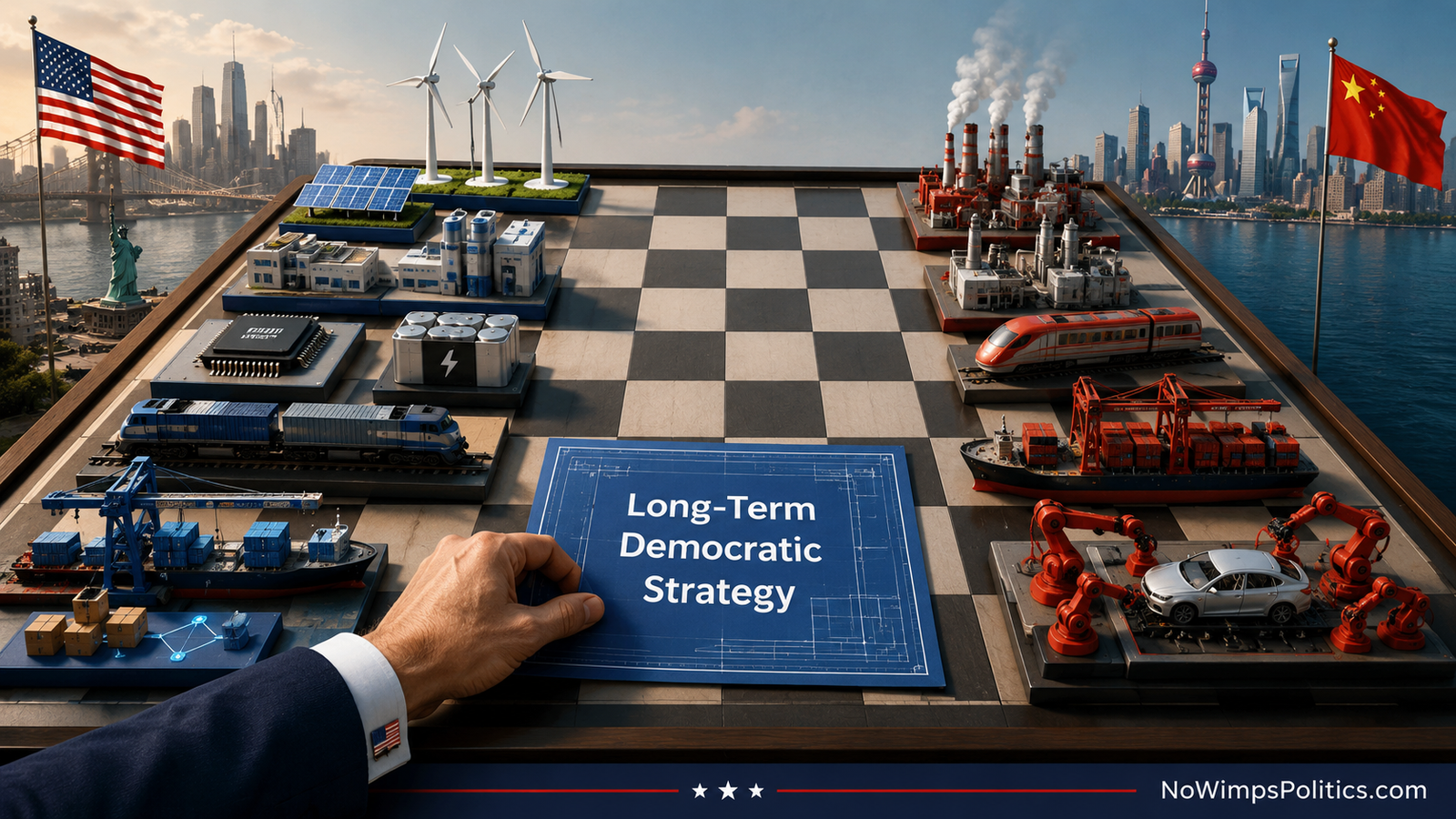
China, meanwhile, plays the long game. We may not like its government. We should not want its system. But we would be fools — and not charming fools, either; the kind with their pants caught in the ceiling fan — to ignore the obvious: long-term planning works.
The question is not whether America should become China. Absolutely not. The question is whether democracy can learn to plan like a serious civilization without surrendering freedom, rights, accountability, or the soul of the republic.
That is the fight.
After WWII, America inherited the industrial high ground
After World War II, the United States did not become the world leader because we were magically smarter, holier, or sprinkled with extra democracy dust by George Washington’s ghost. We became the world leader because we were standing in the middle of a smoking global wreckage yard with our factories still intact.
Europe had been bombed to rubble. Japan had been devastated. Much of the Soviet Union had been carved up, burned, frozen, starved, and brutalized by the Nazi invasion. The United States, meanwhile, had converted itself into the “arsenal of democracy.” By the end of the war, roughly half of the world’s wartime industrial production was in America, helped by the simple but very useful fact that our factories had not been bombed flat. That mattered. A lot. Source: U.S. War Department/Defense Media Activity
Then we did something brilliant: we turned industrial dominance into diplomatic dominance. The Marshall Plan pumped American capital and materials into Europe’s recovery, helping rebuild the continent while also creating markets for American goods. Congress appropriated $13.3 billion for European recovery over four years, which was real money before billionaires started treating tax loopholes like couch cushions full of loose change. Source: National Archives
Bretton Woods gave the postwar economy a new financial skeleton. In 1944, delegates from 44 nations created a monetary framework that established the International Monetary Fund and what became the World Bank Group. The system placed the U.S. dollar at the center of the postwar financial order, which is a pretty good seat at the poker table if you can avoid getting drunk on your own chips. Source: Federal Reserve History
So if you wanted to rebuild after the war, who did you call? American manufacturers, American contractors, American bankers, American weapons suppliers, and American diplomats. America became the store, the bank, the factory, the arsenal, and the referee.
Not a bad business model, if you can keep it.
Spoiler alert: we did not keep it.
America became the store, the bank, the factory, the arsenal, and the referee. Then we got too clever and dismantled our own advantage.
Then America traded industrial strategy for financial engineering
The long slide did not start with Donald Trump. Trump is not the architect of America’s decline. He is more like the drunk guy who found the half-built demolition rig, yelled “I alone can fix it,” and backed the bulldozer through the load-bearing wall.
The damage started earlier, and it was bipartisan. Ronald Reagan helped create the modern anti-union, tax-cut, corporate-power environment. His 1981 tax cut dropped the top income tax rate from 70% to 50%, and Brookings notes that the cut did not pay for itself. Source: Brookings Reagan also fired 11,345 striking air traffic controllers in 1981, turning the PATCO strike into a national signal that organized labor could be treated less like a pillar of the middle class and more like a speed bump. Source: Miller Center
Then Bill Clinton picked up the other end of the crowbar. Clinton-era trade policy sold China’s integration into the global trading system as a golden opportunity for American exports. The Clinton White House called Permanent Normal Trade Relations with China an “historic moment” that would open Chinese markets to American goods and services. Source: Clinton White House archives
And yes, there were benefits. Consumers got cheaper goods. Corporations got cheaper labor. Wall Street got rivers of money. Executives got bonuses large enough to require their own ZIP codes. But the factory towns got the bill.
Harvard Kennedy School summarizes the China trade shock bluntly: China’s rise as the world’s leading exporter, helped by U.S. Permanent Normal Trade Relations in 2000 and China’s WTO accession in 2001, put immense pressure on U.S. manufacturing. Researchers estimate the China trade shock accounted for about one-quarter of the decline in U.S. manufacturing jobs between 2000 and 2007 — roughly 1.5 million to 2 million jobs. Source: Harvard Kennedy School
That was the triple spiral: cheaper goods, so consumers stayed calm; flat wages, because cheap goods softened the pain; and destroyed factory towns, because nobody in the executive suites had to live there. Cities adapted with white-collar jobs, service work, finance, tech, and the great American dream of making PowerPoint decks about synergy. But across industrial America, especially in smaller towns and rural manufacturing regions, the loss was not theoretical. It was the closing of the plant, the death of the union hall, the empty storefront, the opioid clinic, the despair, the rage, and eventually the political arson.
Then along came Trump with a can of gasoline and a Sharpie.
China played the long game
China did not become powerful by accident. China watched. China learned. China waited. China planned.
And here is the part Americans hate admitting: long-term planning works. Not because dictatorship is good. It is not. Authoritarian government is a moral and political trap. It crushes dissent, hides mistakes, abuses minorities, and can turn one leader’s fantasy into national catastrophe. No sane democracy should look at China and say, “Yes, please, give us the surveillance state with extra repression.”
But no sane democracy should look at China’s planning machine and say, “Nah, we’re good with two-year election panic, billionaire-funded propaganda, and a Congress that treats infrastructure like a hostage negotiation.”
China’s manufacturing dominance is now staggering. CSIS’s ChinaPower project reports that China’s manufacturing value-added reached $4.66 trillion in 2023, about 28% of the global total, more than the next three largest manufacturing economies — the United States, Japan, and Germany — combined. Source: CSIS ChinaPower
China also used the Belt and Road Initiative like a geopolitical railroad spike. Griffith Asia Institute reported that Chinese engagement across Belt and Road countries reached a record $213.5 billion in 2025 through construction contracts and investments. Source: Griffith Asia Institute
That is not charity. That is strategy: ports, rail, energy, mining, data centers, roads, manufacturing, political relationships, and resource access. While America was financializing itself into a casino with aircraft carriers, China was building supply chains, financing infrastructure, locking down resources, and positioning itself as the partner of the developing world.
Again, not because China is benevolent. China is not handing out hugs and panda plushies because Xi Jinping woke up feeling cuddly. China is buying influence, leverage, and access to the future.
And America has made the sales pitch easier.
America’s problem is not democracy. It is short-term, bought, chaotic democracy.
Trump promised strength. What he delivered was chaos wearing a red tie long enough to trip over. His tariff wars did not magically rebuild American manufacturing. Reuters reported in April 2026 that Trump launched his second-term China policy by hiking tariffs on Chinese goods to around 145%, but Beijing did not back down. China retaliated, and the two countries eventually reached an uneasy détente after China threatened to restrict rare earth supplies needed by U.S. industries. Source: Reuters
That is not winning. That is picking a fight with the hardware store after outsourcing your toolbox.
China’s leverage is especially dangerous because it dominates key parts of the clean energy and strategic minerals supply chain. The International Energy Agency reported that global lithium-ion battery manufacturing capacity passed 4 TWh by the end of 2025, and China remains deeply dominant in EV and battery supply chains. In 2025, China accounted for 70% of electric car production, over 80% of battery cell production, about 85% of cathode active material production, and more than 90% of anode active material production used in EV batteries. Source: IEA Global EV Outlook 2026
The IEA also warned in its 2025 critical minerals outlook that demand for key minerals such as lithium, nickel, cobalt, graphite, and rare earths keeps growing strongly, and refining remains a concentrated vulnerability. Source: IEA Critical Minerals Outlook 2025
The world noticed the shift. Gallup reported in April 2026 that China edged past the United States in global leadership approval in 2025: 36% approval for China versus 31% for the U.S., one of the widest gaps Gallup has recorded in China’s favor in nearly 20 years. Source: Gallup Pew Research also found in 2025 that views of the U.S. had worsened while opinions of China improved in many surveyed countries, though the U.S. still had higher median favorability than China across 24 countries. Source: Pew Research Center
So no, China has not “won” the world. Not yet. But America has done something worse than lose an argument. We have made ourselves look unserious.
Some people look at China’s rise and conclude that democracy is too slow. Wrong. Democracy is not the problem. Stupid democracy is the problem. Bought democracy is the problem. Gerrymandered democracy is the problem. Democracy run by lobbyists, billionaires, dark money, media monopolies, ideological arsonists, and elected officials who think “governance” means screaming on cable news is the problem.
A government designed in the 1780s for thirteen coastal states cannot compete in the 2020s and beyond without upgrades. That does not mean we throw out democracy. It means we stop treating the Constitution like it was delivered by angels on laminated parchment and start treating it like the operating system of a republic that needs security patches.
The Republican model is already on display: concentrate wealth, protect oligarchs, break regulation, weaken unions, attack voting rights, privatize public goods, and let a handful of ultra-rich autocrats run the country like their personal golf club. How’s that working out?
The strongman model is also on display: hand power to a would-be dictator, watch corruption bloom like toxic algae, and then act surprised when the swamp turns into a luxury spa for grifters. No thanks.
Democracy, with all its failings, hairy warts, committee hearings, procedural constipation, and migraine-inducing complexity, is still the best system for keeping power in the hands of ordinary citizens. But democracy needs a long-range sensor array.
Right now, America changes direction every election cycle like a squirrel trying espresso for the first time. One administration builds a policy. The next one tears it down.
One party funds clean energy. The other party tries to feed the solar panels into a wood chipper.
One administration tries industrial policy. The next administration treats it as treason because it has the previous president’s fingerprints on it.
That is not strategy. That is national whiplash.
The lesson is not “become China.” The lesson is “stop running the world’s most powerful democracy like a quarterly earnings call with nuclear weapons.”
The fix: a National Long Game Council
America needs one core reform that ties all the others together: a legally protected, nonpartisan National Long Game Council.
Not a dictatorship. Not a Politburo. Not a billionaire advisory board. Not a Washington swamp aquarium where failed consultants go to molt. The council should not run the country, replace Congress, command agencies, write secret laws, or hand commandments down from Mount Spreadsheet. Its job should be memory, measurement, forecasting, and long-term strategy.
The Organisation for Economic Co-operation and Development (OECD) describes strategic foresight as a way for policymakers to identify future opportunities, challenges, risks, and disruptions so governments can become more effective over time. Source: OECD
Other democracies already do parts of this. Finland has a parliamentary Committee for the Future that serves as a futures, science, and technology policy body. Source: Parliament of Finland Singapore has a Centre for Strategic Futures whose mission is to help the government navigate emerging strategic challenges and opportunities. Source: Singapore Centre for Strategic Futures Taiwan’s National Development Council formulates national development goals, strategies, and policy priorities across ministries. Source: Taiwan National Development Council
America does not have to copy any of these systems wholesale. But we should stop pretending long-term planning is suspicious just because China is good at it. Fire is useful too. The fact that arsonists use it does not mean we cook dinner with cold rocks.
The National Long Game Council should look 10, 20, and 30 years ahead and identify the industries, technologies, resources, security risks, infrastructure needs, education needs, climate threats, demographic shifts, and economic vulnerabilities that will determine whether America remains powerful.
Every four years, it should publish a public National Long Game Map, with annual updates. That map should not be treated as holy scripture. It should be treated as the country’s best available strategic chart — public, testable, revisable, and impossible to quietly bury under a pile of donor checks.
No elections. No hand-picked political pets. No celebrity experts.
Here is where the council must be different from the usual Washington machinery. Its members should not be elected by campaign theater, and they should not be hand-picked by politicians. The public can be brilliant, decent, generous, and brave. The public can also be manipulated by money, fear, propaganda, tribal identity, billionaire media empires, and demagogues waving flags while quietly looting the furniture.
But politicians should not get to stuff the council with loyalists either. Politicians, as a species, can find a way to ruin a sandwich. Give them a brilliant idea and they’ll pack it with donors, lobbyists, ideological pets, and somebody’s nephew who “has always been interested in policy.”
So the selection process should be brutally merit-based. Republicans are always talking about meritocracy, usually right before handing power to a golfing buddy, donor, cable-news performer, or think-tank ideologue who has been wrong about everything since the fax machine era. Fine. Let’s use real meritocracy.
The council should have seven members maximum: enough for diversity of thought, small enough to make decisions. Candidates should pass through a public, competitive, anonymized testing pipeline before they become eligible for any formal appointment.
Unfortunately, federal constitutional law may require official federal officers to be formally appointed through recognized channels, the legal design matters; the Appointments Clause requires principal officers to be nominated by the President and confirmed by the Senate, while Congress can allow different appointment methods for inferior officers. Source: Constitution Annotated
So the safest model is this: politicians may be stuck with a formal role, but they should not control the candidate pool. They should only be able to confirm or reject finalists who have already earned their place through competitive testing, documented performance, and public standards. No patronage. No donor swaps. No “my college roommate knows China because he once bought a wok.”
The Federal Reserve offers one useful comparison: its Board of Governors has seven members with staggered 14-year terms, which insulates monetary policy from daily political mood swings. Source: Federal Reserve The Long Game Council should borrow the insulation, not the elite-clubhouse vibes.
Staggered long terms, removal only for cause, strict conflict-of-interest rules, no stock trading, no revolving-door lobbying, no party office, and full public disclosure of methodology should be baseline requirements. If someone wants power, fame, cable-news bookings, or a future lobbying mansion with heated floors, they should fail the test before the first coffee break.
Test for judgment, not just credentials
The council should not be stacked with people who merely sold themselves as “experts.” America has no shortage of experts. Some are brilliant. Some are ideological vending machines with graduate degrees. Some are just wrong in a deeper voice.
The problem is that we rarely track whether experts are actually good at prediction, planning, or decision-making. We reward confidence, credentials, proximity to power, and the ability to say “geostrategic paradigm shift” without being laughed out of the room. That is not the same as wisdom.
Candidates for the National Long Game Council should be tested on strategic reasoning, forecasting accuracy, systems thinking, historical pattern recognition, technological literacy, economic literacy, risk analysis, ethical judgment, crisis simulation, AI fluency, and the ability to change their minds when evidence changes. They should also be screened for traits that destroy serious institutions: narcissism, authoritarianism, impulsiveness, corruption risk, ideological rigidity, power hunger, and the kind of ego that hears “teamwork” and thinks “audience.”
Not because we need perfect people. Perfect people do not exist, and anyone claiming to be one should be escorted gently away from the launch controls. The goal is not to find famous experts. The goal is to find people who are unusually good at thinking clearly about the future.
Give the council superforecasters and a built-in troublemaker
This is where America should steal from the best research available. In Superforecasting, Philip Tetlock and Dan Gardner describe how some people can make unusually accurate predictions by using careful probability estimates, constant updating, intellectual humility, and disciplined thinking.
This is not magic. It is not prophecy. It is not a psychic hotline for policy nerds. It is a skill.
The Good Judgment Project grew out of IARPA’s ACE program, which was designed to improve the accuracy, precision, and timeliness of intelligence forecasts. Source: IARPA Good Judgment says its Superforecasters beat competing teams in that government-sponsored forecasting tournament. Source: Good Judgment
That matters. If America is going to plan for the next 30 years, it should not rely only on officials, donors, celebrity economists, generals, lobbyists, or think-tank warriors. The council should have a permanent superforecasting advisory network whose job is to test assumptions, quantify uncertainty, track predictions, update probabilities, and warn when the country is marching confidently toward a cliff while singing the national anthem.
The council should also have a formal dissent role: the Tenth Person Rule, even if there are only seven members. When everyone agrees too quickly, someone is assigned to attack the plan.
Not performatively. Not as a troll. Not as the office goblin whose only contribution is “What if this all sucks?”
Their job is disciplined opposition: find the weak points, blind spots, hidden costs, second-order consequences, enemy countermoves, and missed opportunities. The military calls this red-teaming. Good organizations use it. Bad organizations call it negativity and then act surprised when reality kicks in the door.
Every major plan should come with a public dissent memo. Not because the dissent is always right, but because unchallenged certainty is how smart people build stupid disasters.
This is where I like to mention my favorite quote from Robert Greene: “What makes people stupid, is their certainty that they have all the answers.”
A serious country keeps score. A failing country lets every politician tell a new bedtime story every election season.
Give democracy a public scoreboard
The National Long Game Council’s real power should not be command. It should be memory.
Every major policy connected to the National Long Game Map should be tracked on a public scoreboard: what problem it was meant to solve, what metrics define success, how much money was allocated, who received the money, what results were achieved, what failed, what needs repair, and which politicians supported, opposed, sabotaged, or quietly took credit for it later.
This is not some exotic fantasy from Planet Spreadsheet. The Government Accountability Office has already developed 13 evidence-based policymaking practices to help federal leaders use evidence to manage and assess the results of federal efforts. Source: GAO Good. Now make that spirit public, permanent, and impossible to smother in committee double-talk or political rhetoric.
No more “trust us.” If democracy has taught us anything, it’s that no politician can be trusted. Ever.
No more legislation by fog machine. No more billion-dollar programs disappearing into a contractor swamp where accountability goes to die wearing a lanyard. If a policy works, expand it. If it fails, fix it. If it was a donor payoff disguised as public policy, drag it into the sunlight and let democracy apply disinfectant.
The council should also keep America focused on the real industrial battlefield. The National Academies said in May 2026 that the United States should substantially strengthen Manufacturing USA and issue a national industrial manufacturing strategy; its report notes that successful international competitors embed manufacturing programs inside broader national industrial strategies. Source: National Academies
Translation: everybody else brought a map, and America is wandering around the battlefield asking if anyone has seen its pants.
A real long-game map would identify sectors that determine national survival and prosperity: semiconductors, AI infrastructure, advanced manufacturing, critical minerals, battery production, grid modernization, clean energy, biotechnology, aerospace, shipbuilding, ports, rail, logistics, cybersecurity, water security, robotics, and automation. This does not mean the government picks every winner. It means the government identifies the battlefield and aligns tax policy, public investment, procurement, workforce training, research funding, infrastructure, trade rules, and national security policy around winning that battlefield.
That is not socialism. That is strategy. America used to understand this. We built the interstate highway system, NASA, the early internet, land-grant universities, public research institutions, and the arsenal of democracy. Then we got conned into believing that the only legitimate economic policy was letting corporations offshore the factory, dodge the tax bill, underpay the worker, and ask for a bailout when the supply chain snapped.
Enough.
Give the council guardrails like an AI system
This is where modern government should learn something from AI. When we build serious AI workflows, we do not just say, “Good luck, robot buddy, try not to burn down the village.” We give the system context, instructions, constraints, safety rules, evaluation standards, mission documents, memory files, and guardrails.
Government needs the same thing.
The National Long Game Council should operate under a written national strategy charter — basically the .md file for the republic. Its guardrails should be public and simple enough for ordinary citizens to understand: protect constitutional democracy, protect civil liberties, strengthen the middle class, reduce corruption, preserve national security, increase productive capacity, avoid unnecessary war, prepare for climate, technological, financial, biological, and geopolitical shocks, track results publicly, update forecasts when evidence changes, and never allow one party, one president, one donor class, one ideology, or one industry to capture the process.
No hidden priesthood. No secret technocracy. No philosopher kings in better suits. Just disciplined planning under democratic guardrails.
And yes, this council should be independent enough that political parties cannot casually bend, staple, mutilate, or bury its findings whenever facts become inconvenient. But independence does not mean secrecy. The council should publish its assumptions, forecasts, minority reports, scorecards, conflicts of interest, and corrections. If it gets something wrong, the correction should be public. If reality changes, the update should be public. If a politician ignores the map, that should be public too.
That last part is where Washington will start sweating through the upholstery.
Good.
Why this matters
Greek democracy failed. The Roman Republic failed. Not because democracy is foolish, but because democracy is fragile when it cannot control ambition, corruption, inequality, factional rage, demagoguery, and the concentration of power.
Sound familiar?
Democracy does not die only when soldiers storm the capital. Sometimes democracy dies because it cannot plan past the next election. Sometimes it dies because wealthy factions capture the system. Sometimes it dies because citizens get exhausted and hand power to someone who promises order. Sometimes it dies because every good idea gets mangled by the people assigned to implement it.
America’s challenge is not just to beat China. America’s challenge is to become a democracy mature enough to survive the long game. That means planning without dictatorship, expertise without elitism, merit without buddy systems, independence without secrecy, AI without surrendering human judgment, forecasting without pretending anyone can see the future perfectly, and democracy without resetting the national brain to factory settings every four years.
China has shown the world what long-term planning can do under authoritarian control. America’s mission is to prove democracy can do it better — without surrendering freedom, rights, or the soul of the republic.
The choice
China has a plan. America has a choice.
We can keep staggering from election to election, tearing down our own policies, worshiping billionaires, insulting allies, ignoring workers, starving public institutions, and pretending tariffs are an industrial strategy. Or we can build democratic long-term planning powerful enough to compete with authoritarian state capitalism without becoming authoritarian ourselves.
That is the real test. Not whether America can bully the world. Not whether America can slap tariffs on everything that moves. Not whether America can shout “USA! USA!” loudly enough to drown out the sound of another factory closing.
The test is whether democracy can grow up. Whether democracy can plan. Whether democracy can learn. Whether democracy can remember. Whether democracy can build institutions strong enough to survive the tantrums of temporary politicians.
America became the world leader once because we built, financed, organized, protected, and persuaded. We can do it again. But not with corruption. Not with oligarchy. Not with dictatorship. Not with quarterly earnings reports pretending to be national strategy.
Democracy can win the long game.
But first, it has to admit there is one.
Democracy will not save itself. If you want strategy, spine, and a country that remembers how to build, stick with No Wimps Politics. Join the Wolverines.




0 Comments