

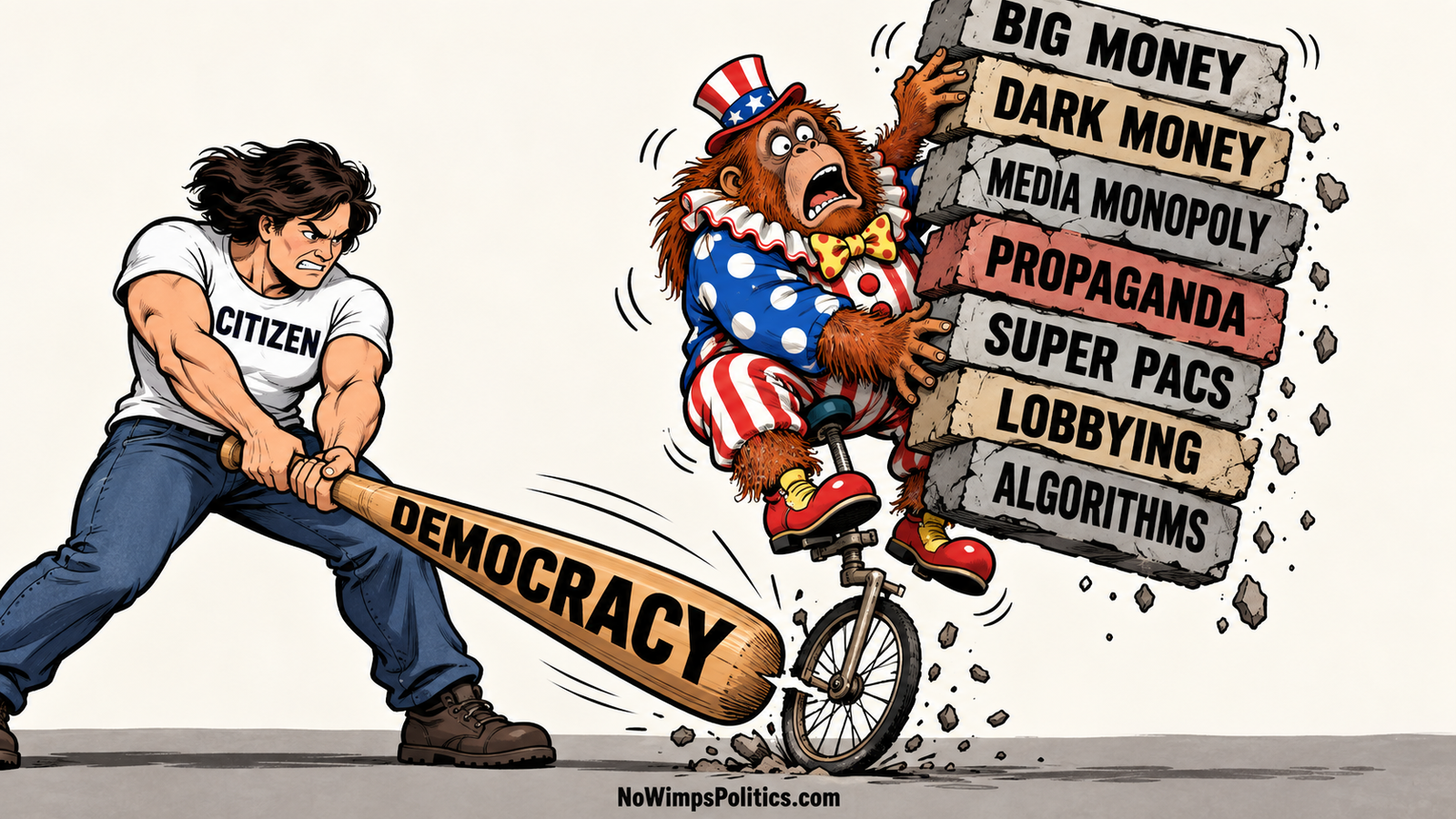
Don’t ban conservatives. Don’t censor them. Take apart the machine that lets billionaires, propaganda networks, dark money, and ideological extremists overpower American democracy.
First, a clarification.
When I say destroy the Far Right political machine, I am not talking about destroying Republicans.
I am not talking about silencing conservatives.
I am certainly not talking about hurting anybody.
A democracy needs a political right.
Conservatives have every right to argue, organize, vote, publish, donate, campaign, and try to persuade their fellow citizens.
That’s democracy.
But the Far Right is not merely “the people to the right of me.”
It is not ordinary conservatism.
It is not your uncle who wants lower taxes and complains about regulations.
By the Far Right, I mean the coalition of authoritarian, oligarchic, white-nationalist, nativist, misogynistic, anti-pluralist, Christian-nationalist, anti-immigrant, anti-democratic forces that have spent decades building a machine inside American politics.
It includes billionaire funders, dark-money networks, propaganda outlets, ideological think tanks, anti-democracy legal activists, religious extremists who want government-sponsored religion, anti-abortion absolutists, voter-suppression operators, and movements hostile to liberal democracy itself.
In plain English:
I mean the faction that does not merely want to win arguments inside democracy.
I mean the faction that wants to rig the machinery of democracy so ordinary citizens matter less and concentrated power matters more.
That is the enemy.
And what I want to destroy is not its voters, but its machinery.
The machine.
The network of billionaire money, tax-advantaged ideological infrastructure, Super PACs, think tanks, lobbying operations, media empires, propaganda outlets, algorithmic megaphones, political operatives, and revolving doors that can convert the preferences of a relatively small number of extremely wealthy and ideological actors into national political power.
Because here is the mistake defenders of democracy keep making:
We keep fighting the Far Right as though it were merely an argument.
It isn’t.
It’s infrastructure.
And you don’t defeat infrastructure with a devastating Facebook reply.
You map it.
You expose it.
You change the rules that feed it.
You dismantle its unfair advantages.
And then you build something better.
Piece by piece.
The Far Right Figured Out Something Its Opponents Didn’t
Political power isn’t built six months before an election.
It is built between elections.
For decades, conservative institution-builders invested in think tanks, judicial networks, litigation, lobbying groups, media, candidate recruitment, policy development, donor networks, activist training, personnel pipelines, and organizations designed to survive from one administration to the next.
Then came perhaps the clearest demonstration of the strategy:
Whatever you think of its politics, admire the engineering.
The Heritage Foundation didn’t merely publish a conservative Christmas list and hope somebody in the next Republican administration found it next to the copier.
Project 2025 was explicitly built around four components:
a policy agenda, personnel recruitment, training, and a 180-day implementation playbook.
Heritage said its coalition reached 100 organizations.
That is not a bumper sticker.
That is not a campaign slogan.
That is not six interns and a Substack.
That is a political machine.
And while it was being built, a remarkable amount of the opposition’s energy was consumed arguing about tweets, personalities, polling bumps, and whatever outrage had been freshly delivered by the internet that morning.
Guess who arrived better prepared?
Here is Political Reality Rule #1:
If your opponent has a factory and you have a protest sign, eventually the factory wins.
So stop whining about the factory.
Let’s take it apart.
1. Stop Giving Political Machines a Tax-Advantaged Free Ride
Let’s start with Heritage.
The Heritage Foundation identifies itself as a 501(c)(3) charitable organization, and charitable contributions to it can be tax-deductible. Heritage also has a separate 501(c)(4) sister organization, Heritage Action for America.
Nothing inherently wrong with that.
America should have conservative think tanks.
America should have liberal think tanks.
America should have libertarian think tanks, socialist think tanks, centrist think tanks, and preferably one well-funded institute devoted entirely to figuring out how printers know you’re in a hurry.
Ideas are good.
Policy research is good.
Political education is good.
But there is a legitimate question hiding underneath all this:
Where should tax-supported charitable activity end and partisan political machinery begin?
Current law already draws a line.
Good.
Keep that protection for legitimate research and advocacy.
But modern political infrastructure has become vastly more sophisticated than the tax code’s mental picture of a professor publishing a policy paper and then wandering back to his office for tea.
Organizations today can develop policy, train personnel, cultivate activists, organize litigation, shape public debate, educate voters, recruit experts, prepare transition plans, and build entire ideological ecosystems.
Some of that is perfectly legitimate.
But the boundaries should be bright enough that ordinary citizens don’t need a tax attorney, a forensic accountant, and Indiana Jones to figure out who is financing what.
So here is the reform:
Write clearer, ideology-neutral rules distinguishing genuine charitable education and research from partisan campaign machinery.
Require stronger disclosure of large funding streams where constitutionally permissible.
Aggressively enforce existing campaign-intervention rules.
Increase transparency around affiliated organizations when money, personnel, campaigns, and advocacy operations overlap.
And apply the exact same rules to everybody.
Heritage.
Progressive organizations.
Environmental groups.
Religious organizations.
Billionaire-funded foundations.
Your cousin Larry’s Foundation for Replacing Congress With Golden Retrievers.
Everybody.
If Heritage thrives under clear, transparent, evenly enforced rules?
Fine.
That’s democracy.
If a progressive organization thrives under those rules?
Also fine.
The goal isn’t:
Kill organizations whose politics I dislike.
The goal is:
Stop using America’s tax system to create hidden political leverage for anyone.
Left.
Right.
Center.
Or Larry.
2. Stop Selling Political Power by the Billion
Now we arrive at Elon Musk.
And I am about to say something that may shock approximately seventeen people on the internet.
Elon Musk has every right to talk about politics.
As much as he wants.
He can endorse candidates.
Criticize candidates.
Start political organizations.
Write twelve thousand posts before lunch.
He can stand on the roof of Tesla headquarters wearing a cowboy hat and explain monetary policy through interpretive dance.
First Amendment.
Knock yourself out.
What Elon Musk should not have is the First Amendment Platinum Billionaire Founder’s Edition, which apparently comes bundled with vastly more political influence than the model issued to everybody else.
So America has basically said:
“Bob, you may give the candidate $3,500.”
“Elon, there’s a loading dock around back.”
And the machinery isn’t theoretical.
And as the 2026 midterms approach, America PAC is again spending in competitive races.
But this isn’t really about Elon Musk.
He’s just the world’s largest illuminated arrow pointing toward the problem.
Replace Musk with:
George Soros.
Michael Bloomberg.
Peter Thiel.
Jeff Bezos.
A giant corporation.
A giant union.
A hedge-fund billionaire.
A cryptocurrency billionaire.
Or some future trillionaire who owns six billion intelligent toaster ovens and has decided America desperately needs his thoughts on agricultural policy.
Same rule.
A democracy cannot survive indefinitely if money can be converted into political power at industrial scale.
Wealth should let you buy a yacht.
It should let you buy twelve yachts.
It should even let you commission a yacht with a smaller yacht inside it, assuming you have unresolved emotional issues.
It should not let you buy a larger share of American democracy.
So change the system.
Create robust public financing for qualifying campaigns.
Build small-donor matching systems that make ordinary voters financially relevant again.
Require fast disclosure of major political expenditures.
Make it harder to hide political money behind shell organizations.
Strengthen anti-coordination rules so “independent” expenditures are actually independent.
Give regulators the resources and authority to enforce the rules.
And confront the constitutional doctrines that make reasonable limits on enormous independent political spending so difficult.
If changing that ultimately requires a constitutional amendment?
Fine.
The Constitution isn’t the Dead Sea Scrolls.
We’ve amended it twenty-seven times.
3. Build a Firewall Against Media Oligarchy
Now we reach something potentially even more powerful than campaign money:
control over information.
The Founders worried about kings.
They did not anticipate a private citizen worth hundreds of billions of dollars purchasing a global communications platform before lunch.
Technology changed.
Human nature did not.
Power still wants more power.
And communications power is political power.
That is why the direction of American media policy right now should alarm anyone who dislikes oligarchy.
Fantastic.
Because when I look at modern America, the problem that immediately leaps out at me is:
Not enough media consolidation.
Apparently, what our democracy has been missing is the opportunity for fewer people to control more of what everybody else watches.
What could possibly go wrong?
The answer is not to punish conservative media.
It is to prevent media oligarchy.
That distinction is crucial.
A conservative newspaper is not the problem.
A liberal network is not the problem.
A libertarian website is not the problem.
The problem begins when enormous concentrations of wealth gain control over enough newspapers, stations, platforms, algorithms, distribution systems, advertising networks, or digital infrastructure that a tiny number of private actors acquire extraordinary power over the national conversation.
That is dangerous whether the billionaire involved votes Republican, Democratic, Libertarian, or Klingon.
Congress should rebuild meaningful media-ownership safeguards.
Establish reasonable limits on excessive concentration.
Protect local competition.
Apply serious scrutiny to mergers involving major news and information companies.
Use antitrust law when acquisitions substantially reduce competition.
Protect independent and local journalism.
And pay attention to cross-platform control.
If one economic empire controls content, distribution, advertising, algorithms, infrastructure, and access to audiences, that’s not merely a successful company.
That’s a private chokepoint on public discourse.
A democracy in which 340 million people theoretically govern themselves while a handful of extremely wealthy people control much of what those citizens see, hear, search, click, and discuss has developed a structural problem.
That’s not automatically dictatorship.
But you can see dictatorship from there.
4. Don’t Shut Down Fox News
Yep.
I said it.
Don’t shut down Fox News.
Don’t have the government decide which cable network is sufficiently truthful to remain on television.
Don’t create a federal Ministry of Truth.
Don’t create a Federal Bureau of Correct Opinions.
Don’t give some future president a giant red button labeled:
REMOVE NETWORK I FIND ANNOYING.
Because sooner or later the political faction you hate will control that button.
Then everybody suddenly becomes Thomas Jefferson.
Instead:
Make actionable lies expensive.
America already has an institution for determining whether damaging factual claims cross the legal threshold for defamation.
It’s called a court.
In 2023, Fox agreed to pay Dominion Voting Systems $787.5 million to resolve Dominion’s defamation litigation. Fox also acknowledged the court’s rulings finding certain Dominion claims false.
That is what lawful accountability looks like.
No Ministry of Truth.
No government censor deciding which opinions Americans may hear.
A plaintiff.
Evidence.
Discovery.
Lawyers.
A judge.
And potentially very expensive consequences.
Good.
Let the courts do what courts are for.
Due process.
Evidence.
Rules.
But government can still improve the information ecosystem without becoming its editor.
Require transparent sponsorship of political advertising.
Maintain searchable political-ad databases.
Protect investigative journalism.
Protect legitimate defamation remedies.
Encourage clearer distinctions between reporting and commentary.
Apply competition law where media concentration creates genuine monopoly problems.
Fox can remain conservative.
MSNBC can remain liberal.
Everybody gets opinions.
Nobody gets alternative facts with diplomatic immunity.
5. Put the Algorithms Under Glass
Rupert Murdoch’s generation owned television networks and newspapers.
Today’s information empires own something potentially more powerful:
the switchboard deciding what everybody sees.
Facebook.
YouTube.
TikTok.
X.
Search engines.
Recommendation engines.
AI systems.
These platforms do not merely contain information.
Software decides what gets amplified.
What gets buried.
What gets recommended.
What gets pushed onto millions of screens before breakfast.
And engagement algorithms discovered something astonishing about human psychology:
Anger works.
Fear works.
Tribal warfare works.
Conspiracy works.
A thoughtful 4,000-word examination of agricultural trade policy?
Apparently not quite as sexy.
Who knew?
Again, the solution is not government control of acceptable opinion.
It is transparency, competition, and user control.
Major platforms should explain the basic mechanics and incentives of recommendation systems.
Qualified independent researchers should have privacy-protected access necessary to investigate systemic manipulation.
Users should be given meaningful alternatives to engagement-maximizing feeds.
Political advertising should exist in permanent, searchable public archives.
Coordinated bot networks and paid influence operations should face disclosure requirements consistent with constitutional protections.
Dominant platforms should face serious competition scrutiny.
Interoperability and data portability should make it easier for users to leave dominant platforms without abandoning their entire digital lives.
Regulators should concentrate on:
competition,
fraud,
transparency,
market power,
deceptive conduct,
and systemic manipulation.
Not ideology.
If an algorithm shows people conservative material because users genuinely want conservative material?
Fine.
If it shows liberal material because users genuinely want liberal material?
Fine.
If it quietly discovers that making Americans hate one another boosts quarterly revenue?
Maybe the Americans should be allowed to inspect the machine.
6. Kill Dark Money With Daylight
Political money loves darkness for approximately the same reason cockroaches do.
Life gets harder when somebody turns on the kitchen light.
Americans should be able to know who is spending enormous sums trying to influence their votes.
Not six months after the election.
Not after tracking money through seven LLCs, four nonprofit organizations, a Super PAC, two consultants, and something called:
Citizens for Freedom, Puppies and Definitely Not Three Billionaires.
Before they vote.
Require timely disclosure of major election spending.
Require meaningful disclosure of major funding sources for political advertising where constitutionally permissible.
Make shell-company political spending traceable to real beneficial owners.
Create serious penalties for deliberately disguising political expenditures.
Modernize campaign-finance reporting.
And build enforcement agencies capable of doing something more intimidating than sending a strongly worded PDF.
Transparency won’t eliminate wealthy political influence.
But oligarchy works much better in the dark.
Turn on the lights.
7. Break the Revolving Door
Another gear in the political machine is the revolving door between:
government,
lobbying,
corporations,
campaigns,
think tanks,
media,
consulting firms,
and back into government again.
Changing jobs does not make somebody corrupt.
But incentives matter.
Imagine regulating an industry Monday while knowing that the industry’s lobbying operation may offer you $700,000 a year on Friday.
I’m sure that possibility has no influence whatsoever.
Human beings are famously immune to money.
Strengthen cooling-off periods for senior officials.
Expand meaningful financial disclosures.
Close loopholes in lobbying registration.
Require disclosure of who actually finances major lobbying campaigns.
Strengthen conflict-of-interest laws.
Restrict certain lobbying by senior former officials for meaningful periods.
And enforce the rules.
Again:
same rules for everyone.
Republicans.
Democrats.
Conservatives.
Liberals.
The revolving door does not become ethically pure because it spins counterclockwise.
8. Stop Trying to Destroy Their Ideas
Here’s where democracy advocates often screw this up.
Bad ideas cannot simply be prohibited out of existence.
Trying often makes them sexier.
Tell Americans a book is forbidden and suddenly half the country wants three copies.
The answer to bad ideas is better ideas.
The answer to propaganda is journalism.
The answer to conspiracy theories is evidence.
The answer to authoritarianism is democratic institutions that visibly work.
And the answer to an extraordinarily well-organized political movement is—
Brace yourself—
organization.
The Far Right built think tanks.
Build better institutions.
They developed policy before elections.
Do the same.
They developed personnel pipelines.
Do the same.
They trained future government officials.
Do the same.
They funded litigation.
Build powerful constitutional-democracy legal organizations capable of playing the same long game.
They developed media ecosystems.
Build independent journalism.
They organized locally.
Show up locally. Organized workers also create lasting counterpower; see Collective Bargaining Power: How Workers Fight Back When Government Serves the Rich.
They understood that state legislatures, courts, county offices, election boards, and school boards matter.
Pay attention to them.
They planned in decades.
Stop thinking in news cycles. America pays for that short-term thinking far beyond domestic politics, as I argued in How America Lost the Long Game to China—and How Democracy Can Win It Back.
Politics is not magic.
It is infrastructure.
9. Build the Pro-Democracy Machine
This may be the most important step.
Because if you dismantle anti-democratic infrastructure without building democratic infrastructure, you create a vacuum.
And vacuums attract extremists like unattended potato salad attracts flies.
America needs a pro-democracy ecosystem capable of thinking twenty years ahead.
Not a Democratic Heritage Foundation.
Not MSNBC with better snacks.
Not a left-wing version of the same oligarchy.
Something larger.
A network of institutions committed to constitutional democracy regardless of which legitimate political party wins the next election.
It should include:
independent journalism,
anti-corruption organizations,
voting-rights groups,
election-administration experts,
constitutional scholars,
policy institutions,
local civic organizations,
public-interest law firms,
democracy-oriented philanthropies,
citizen education,
leadership-development programs,
anti-disinformation research,
government-modernization efforts,
and serious long-term strategic planning.
Republicans who believe in constitutional government should be welcome.
Democrats should be welcome.
Independents should be welcome.
Conservatives.
Liberals.
Moderates.
Libertarians.
People who disagree bitterly about taxes, abortion, climate policy, immigration, gun laws, health care, education, and approximately everything else humans have figured out how to argue about.
The admission requirement shouldn’t be ideology.
It should be one question:
Do citizens choose their government—or do powerful people choose it for them?
That is the dividing line that matters.
And One More Thing: Fix Democracy So the Machine Has Less to Exploit
Political machines flourish when democratic institutions are weak.
So this project cannot end with campaign-finance reform and antitrust law. It also requires the institutional repairs laid out in Our Democracy Is a 250-Year-Old Fixer-Upper—How to Remodel It.
We also need:
independent election administration,
fair congressional districts,
strong voting rights,
modern election infrastructure,
serious congressional ethics enforcement,
transparent government records,
enforceable anti-corruption laws,
strong inspectors general,
protected whistleblowers,
and election systems in which politicians have fewer opportunities to select their voters instead of voters selecting their politicians.
The point is not to engineer Democratic victories.
The point is to engineer democratic legitimacy.
Sometimes conservatives should win.
Sometimes liberals should win.
That’s democracy.
But they should win because citizens chose them.
Not because somebody found a new loophole in the operating system.
Turn the Argument Into Action
You do not need a billionaire’s loading dock to start. You need information, a phone, and enough civic stubbornness to use both.
- Find and contact your federal, state, and local elected officials.
- Follow federal political money in the FEC’s public records.
- Follow No Wimps Politics on Bluesky.
- Share this argument on Bluesky.
Then use the comments. Tell me what this plan gets right, what it misses, and which piece of the machine you think matters most.
This Isn’t About Destroying the Right
America needs a political right.
It needs conservatives asking whether government has become too powerful.
It needs liberals asking whether concentrated wealth has become too powerful.
It needs libertarians shouting about individual liberty.
It needs social democrats shouting about inequality.
It probably even needs that guy at Thanksgiving who has a forty-seven-minute theory involving gold, fluoride, the Federal Reserve, and something his barber heard on a podcast.
Democracy is messy.
That’s the deal.
What America does not need is an oligarchic political machine capable of converting concentrated wealth into concentrated political power.
That isn’t fundamentally Left versus Right.
It’s something older.
And simpler.
Democracy versus oligarchy.
So here is the plan.
Don’t ban conservative speech.
Expose political money.
Don’t imprison billionaires for having opinions.
Stop allowing wealth to purchase vastly greater political power.
Don’t outlaw conservative think tanks.
Create transparent, evenly enforced boundaries between charitable activity and partisan political machinery.
Don’t shut down Fox.
Use courts for actual defamation, competition law for actual concentration, and transparency for political influence.
Don’t create government-controlled media.
Prevent excessive private control of the information system.
Don’t tell Americans what they are permitted to believe.
Give them a fighting chance to know who is trying to manipulate them.
Don’t censor algorithms.
Make the machinery visible and give users alternatives.
Don’t merely complain that the Far Right spent decades building political infrastructure.
Build better infrastructure.
Because the goal isn’t to eliminate conservatives.
The goal isn’t to make Republicans disappear.
The goal isn’t revenge.
And the goal sure as hell isn’t replacing right-wing oligarchs with left-wing oligarchs and declaring victory because our billionaires have nicer yard signs.
The goal is to dismantle a system that allows a small collection of billionaires, ideological organizations, media empires, political operatives, concentrated corporations, and enormous pools of money to wield political influence wildly disproportionate to that of ordinary citizens.
Then conservatives can make their case.
Liberals can make theirs.
Socialists can make theirs.
Libertarians can make theirs.
Independents can make theirs.
Larry can continue campaigning for the Golden Retriever Congress.
Everybody gets a microphone.
Everybody gets a vote.
Everybody gets the right to persuade their fellow citizens.
But there is one rule:




0 Comments