

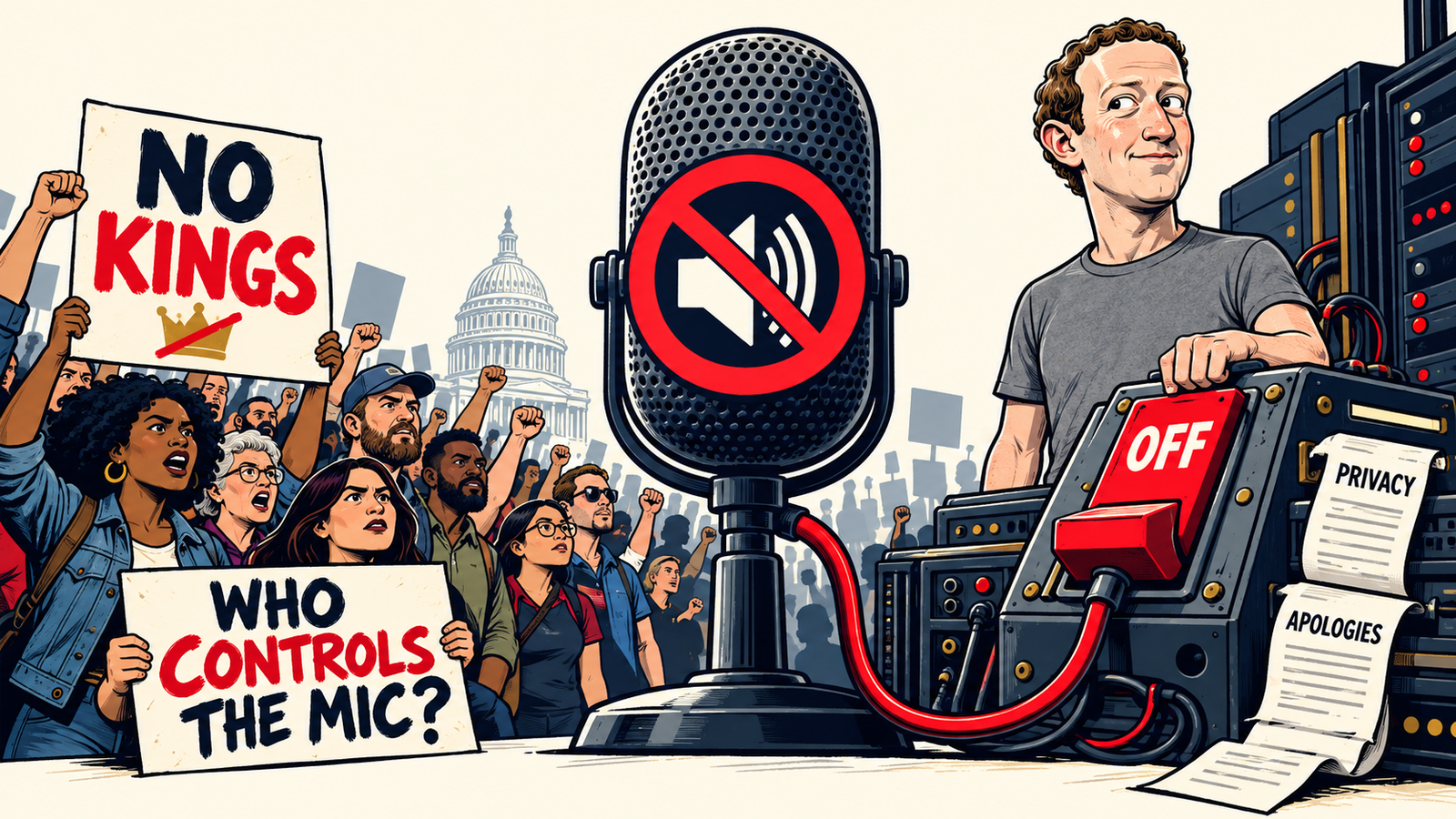
Imagine organizing a nationwide day of civic action, building an audience, announcing events, and getting people ready to vote. Then, while the action is underway, the company hosting your communications pulls the plug.
Later, somebody from corporate communications wanders out with an apology and explains that the machinery got confused.
Well. That should comfort everyone. The company that makes its money delivering messages to precisely selected audiences apparently had trouble letting a democracy movement reach its own.
On Saturday, October 17, 2026, Meta suspended the NO KINGS Coalition’s main Instagram account during its national early-voting mobilization. Organizers reported that restoring the account’s public visibility did not immediately restore their ability to use it. Meta acknowledged an error and blamed an automated system. thewrap.com
Remember that date. And remember which company controlled the switch. We were told to “Zuck” Off.
“The algorithm did it” is an explanation that needs evidence
Reporting placed the account’s disappearance at about 1:30 p.m. Eastern. Indivisible co-founder Ezra Levin described a suspension lasting approximately 90 minutes. The coalition said administrators remained locked out for hours after the public could see the account again. Public visibility and working access were restored at different stages. thewrap.com
Meta attributed the suspension to automated systems responding to high-frequency activity. By Sunday, organizers reported regaining access. businessinsider.com
We do not have evidence that Mark Zuckerberg personally ordered the shutdown. We have an acknowledged failure by the company he leads, at a moment when timely communication mattered.
That is plenty to demand answers about without inventing a secret conference call.
Automation is a management decision. So are testing, staffing, appeals procedures, and whether someone can fix a mistake while the information is still useful.
An apology cannot give organizers back the hours they needed yesterday.
Common Cause condemned the removal as corporate censorship and demanded reinstatement. That is its assessment, rather than proof of deliberate political targeting. But the concern is obvious: civic organizations depend on communications systems that private companies can abruptly disable. Common Cause
Meta should produce a specific incident report. What triggered the suspension? What review occurred? Why did administrators remain locked out? What safeguards failed? What has changed?
“We fixed it” is an appropriate opening response to a broken toaster. This involved a national voting mobilization.
Facebook has been asking us to trust it for a very long time
There is a reason people hear another Facebook apology and start checking their pockets.
In 2011, the Federal Trade Commission charged Facebook with deceiving consumers about privacy. Its allegations included making previously private information public without advance approval, allowing applications broader access than users had been told, and sharing personal information with advertisers despite promises otherwise. The settlement became final in 2012. Federal Trade Commission
The promise was privacy. The alleged practice was considerably more porous.
Then came Cambridge Analytica. The FTC pursued deceptive harvesting of Facebook users’ information. The broader Facebook privacy case also concerned data shared with applications installed by users’ friends, including information belonging to people who had chosen restrictive privacy settings. ftc.gov
Think about that arrangement. You could make a decision about your own privacy, and somebody else’s app installation could still become your problem.
Apparently, friendship came with an undisclosed data-sharing annex.
In 2019, Facebook agreed to a $5 billion penalty to settle FTC charges that it had violated the earlier privacy order. Regulators were addressing alleged violations of protections Facebook was already supposed to observe. Federal Trade Commission
The new order also prohibited using telephone numbers obtained for security features, such as two-factor authentication, for advertising. Federal Trade Commission
You supply information to secure your account. Regulators then have to tell the company to keep that information out of its advertising machinery.
What a magnificent contribution to the advancement of trust.
For accuracy, Cambridge Analytica was not simply a case of Facebook selling everybody’s account. It involved deceptive data harvesting, third-party access, and failures to protect information. The documented allegations are damning enough without improving them through creative writing.
Algorithms do not come with diplomatic immunity
In 2022, the Justice Department reached a settlement with Meta over allegations that its housing advertising system discriminated on characteristics protected by the Fair Housing Act. The agreement required changes to its advertising system, termination of a targeting tool, and independent review. United States Department of Justice
Housing opportunities are not cat videos. Who receives an advertisement can affect who learns that a home is available.
That case does not establish that Saturday’s suspension was intentional or unlawful. It demonstrates something useful: government can investigate algorithmic systems and obtain enforceable changes when evidence supports a legal case.
A company builds software, deploys it, and benefits from its operation. When the software harms people, pointing at the machinery should begin the investigation.
It should not end it.
And yes, there is the Facebook origin story
Cameron and Tyler Winklevoss, along with Divya Narendra, accused Zuckerberg of taking their social-networking idea. Facebook disputed the allegations and countersued. The litigation ended in a settlement involving approximately $65 million in cash and Facebook stock in exchange for ConnectU. Courts subsequently enforced the settlement. law.justia.com
That was a disputed allegation resolved by settlement, rather than a judicial finding that Zuckerberg stole Facebook.
It belongs in the history because the mythology of the solitary, world-improving tech genius deserves scrutiny. But the strongest argument against handing Meta our unquestioning trust rests on the regulatory record.
We do not need a Hollywood screenplay to supply the prosecution’s exhibits.
Free speech matters beyond the government’s front door
The First Amendment generally constrains government. A private platform suspending an account does not automatically establish a constitutional violation. Platforms’ editorial decisions can themselves receive First Amendment protection. supremecourt.gov
That distinction matters when deciding what government can compel. Citizens remain free to criticize corporate gatekeeping, organize boycotts, demand explanations, and push for constitutional reforms.
A democracy can have a serious free-expression problem even when a particular incident does not support a winning First Amendment lawsuit.
Look at the dependence we have created. Movements spend years gathering people on platforms they do not control. They build an audience, establish relationships, and organize events. Then access disappears, and they discover how little control they actually have over reaching those people.
We need to stop building every civic meeting hall on land where a billionaire keeps the only key.
Make the consequences concrete
Anger supplies energy. Organization gives it somewhere useful to go.
Start with advertising money. Businesses and organizations buying Meta ads can suspend discretionary spending and state clear conditions for returning: a credible incident report, functioning appeals, and demonstrated safeguards. Ask advertisers publicly and civilly whether Meta’s handling of civic accounts meets their standards.
If the company wants our money, it can answer our questions.
Build communications Meta cannot switch off. Put websites, email lists, event pages, and direct organizer contacts at the center of civic operations. Participate on Bluesky and other channels while bringing people toward a home you control. Replacing one platform dependency with another leaves the same weakness wearing a different logo.
Preserve evidence. Keep dated screenshots, notices, appeal correspondence, and records of lost access. Separate firsthand observations from things circulating online. A documented chronology is more useful than a thousand furious repetitions of an unverified accusation.
Report actual deceptive practices. People with relevant evidence can submit reports to the FTC or their state attorney general. Minnesota’s Attorney General accepts consumer complaints. Describe the conduct and the harm accurately; filing a complaint does not itself establish wrongdoing or guarantee compensation. Federal Trade Commission
Demand focused oversight. Ask elected officials to seek the incident records, examine enforcement procedures, and investigate any evidence of government involvement through lawful processes. An oversight hearing should produce documents and answers.
We have enough footage of senators struggling to understand the internet.
Government should enforce the law—and improve it
Regulators should investigate evidence of deception, privacy violations, discrimination, unlawful anticompetitive conduct, and breaches of applicable orders. Where violations are established, remedies should address the harm and prevent recurrence.
The housing-ad settlement demonstrates that changing the underlying system can be part of an enforceable remedy. United States Department of Justice
Congress should consider stronger privacy protections, practical data portability, interoperability, independent research access, and carefully designed transparency and appeals requirements. Those proposals need details that respect privacy, security, and protected editorial discretion.
Executive accountability should follow evidence of personal involvement and the requirements of the applicable law. Where evidence supports an individual civil or criminal case, pursue it.
A CEO’s title does not establish guilt. A billionaire’s fortune should not purchase immunity.
Government also should not punish a platform merely because officials dislike its editorial views. Handing politicians that weapon would give the next authoritarian a very convenient instruction manual.
The objective is consistent enforcement and meaningful protection for people who otherwise have little leverage.
Remember who controlled the switch
October 17 exposed a vulnerability every civic organization should take seriously: an established communications channel can disappear precisely when it matters most.
Meta says its automation made a mistake.
Then show the records. Explain the failure. Allow scrutiny. Demonstrate the repair.
Facebook’s history gives the public ample reason to demand verification. Privacy promises, regulatory orders, a multibillion-dollar settlement, and advertising systems requiring government intervention have earned the company something far less comfortable than automatic trust.
We have sat through enough corporate apologies to furnish a congressional hearing room with them.
Make Meta earn trust through observable changes. Make advertising decisions reflect its performance. Build communications it cannot switch off. Demand enforcement wherever the evidence supports it.
No kings in government. No billionaire gets a free pass for controlling the microphone.
Join the Wolverines. Bring your backbone—and the receipts.



0 Comments