

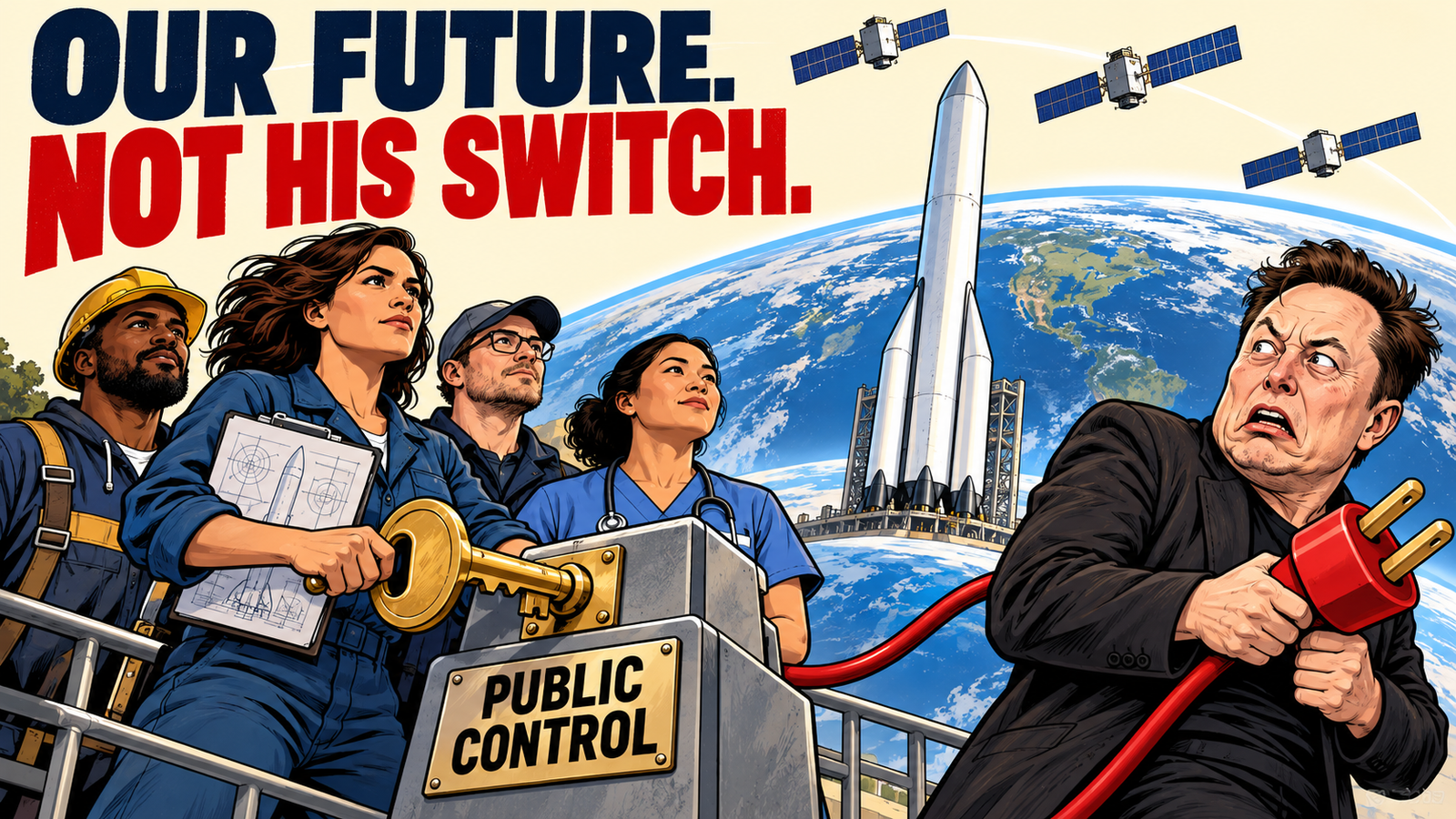
America’s access to space and essential satellite communications should answer to public law. Congress should bring SpaceX’s critical infrastructure into public ownership, protect the people who make it work, and prevent any billionaire or president from treating it as a personal weapon.
Imagine hiring a contractor to build the only practical bridge to your workplace. You pay him to keep it operating. Your colleagues depend on it. Emergency vehicles depend on it.
Then he gets into a political argument and announces that perhaps he’ll start dismantling the bridge.
Would you send him another thank-you card for his entrepreneurial spirit?
Or would you ask why the hell you gave one man that much control?
That is the question America needs to ask about Elon Musk, SpaceX, and Starlink.
Congress should nationalize SpaceX’s critical launch and satellite communications infrastructure, including the essential Starlink assets and capabilities on which public missions depend. Acquire it lawfully. Pay constitutionally required compensation. Keep the engineers, technicians, and mission teams working. Build an accountable public institution around their expertise.
The public should hold the keys to infrastructure that can determine whether astronauts get home, essential communications stay available, and allies can defend themselves.
The threat to pull the plug already happened
In June 2025, amid his public feud with Donald Trump, Musk announced that SpaceX would begin decommissioning its Dragon spacecraft after Trump threatened his companies’ government contracts. Hours later, Musk reversed himself. The spacecraft continued operating. Reuters, June 6, 2025: Musk’s Dragon decommissioning threat and reversal.
Good. But a reversal does not make the original threat disappear.
The national interest cannot depend on whether two powerful men have finished shouting at each other on social media. Astronaut transportation should never become a prop in their argument.
A public contractor can have legal obligations that make walking away difficult. That does not eliminate the disruption, litigation, uncertainty, or political leverage created by dependence on that contractor.
When the service is essential and the replacement takes years, the threat itself is power.
SpaceX is not NASA. Our dependence is still dangerous.
NASA remains a public agency with its own scientists, engineers, facilities, responsibilities, and other contractors. Calling SpaceX “NASA” would erase all of that work.
The real problem is more precise: important public missions rely heavily on capabilities supplied by one company.
NASA’s inspector general reported in June 2026 that Crew Dragon had been certified in 2020, while Boeing’s Starliner remained uncertified following problems in its flight tests. That is a substantial weakness in the promised redundancy. NASA Office of Inspector General, June 30, 2026: Commercial Crew audit.
NASA’s September 2026 announcement of three additional SpaceX crew missions valued the modification at $946 million and the overall SpaceX crew transportation contract at $5.92 billion. Those are contract values, not a calculation of all taxpayer support or money already paid. NASA, September 18, 2026: Three additional SpaceX crew missions.
SpaceX’s workforce has delivered remarkable capabilities. That achievement is a reason to preserve the operation and its technical strength.
It is also a reason to stop confusing admiration for the engineers with permanent acceptance of concentrated control.
We can respect the people building the bridge while deciding the bridge belongs under public ownership.
Ukraine shows what control of the switch means
A Reuters investigation published in July 2025 reported that Musk ordered Starlink coverage cut in parts of Ukraine during its September 2022 counteroffensive. Reuters cited people familiar with the order and people who experienced the resulting communications failures. Reuters investigation, July 25, 2025: Starlink shutdown during Ukraine’s 2022 counteroffensive.
That is reporting about a specific incident. It should not be inflated into a claim that Musk personally controls every satellite decision or every battlefield outcome.
It is serious enough on its own.
The October 2026 restrictions require particular care. Starlink’s commercial service and Starshield’s government and military arrangements should not be treated as interchangeable.
On October 15, Reuters reported that sources traced an order restricting Starshield service to the White House. A senior U.S. official denied that Trump had requested it. Musk said Starshield systems were government-owned and controlled, with usage decisions belonging to U.S. authorities. Reuters, October 15, 2026, updated October 17: White House role in Starshield restrictions.
On October 20, Reuters relayed a Wall Street Journal report alleging that Musk ordered the slowdown and discussed it with Trump. Reuters explicitly said it could not immediately verify that report. Responsibility remains disputed; the newer allegation is not a settled finding. Reuters, October 20, 2026: Wall Street Journal report on Musk and the slowdown.
Congress needs the contracts, instructions, decision records, and sworn testimony needed to establish who did what.
Meanwhile, the policy lesson is already clear: essential service must have a defined chain of lawful authority, enforceable obligations, and operational alternatives.
“Ask the billionaire” and “ask someone in the White House” are both lousy answers to a missing chain of accountability.
The political money makes the concentration worse
Reuters reported on October 12 that Musk had spent about $366 million during the 2026 midterm cycle, including $276 million since July to help Republicans retain Congress. Reuters, October 12, 2026: Musk’s midterm spending.
His political activity extends abroad. In January 2025, he urged Germans to vote for the far-right Alternative for Germany during a broadcast with its leader on X. Reuters, January 9, 2025: Musk’s endorsement of Germany’s AfD.
Political advocacy alone cannot justify taking someone’s property. A constitutional democracy must protect political rights, including those of people whose views we despise.
But the combination of political spending, government business, regulatory access, and control of essential infrastructure demands scrutiny. The people deciding how to supervise an indispensable supplier should not be able to ignore that supplier’s extraordinary political influence.
Public acquisition must rest on a demonstrable public need: dependable access, continuity, security, and accountable control. That case should survive regardless of which party a future owner supports.
Would we accept the same arrangement if the billionaire funded Democrats? The answer should be the same.
Investigate corruption. Do not substitute slogans for evidence.
There are concrete matters to investigate.
In February 2025, Senator Edward Markey questioned the FAA’s deployment of Starlink terminals and the conflicts created by Musk’s overlapping business and government roles. In May, Senators Elizabeth Warren, Mark Warner, Jeanne Shaheen, and other lawmakers sought an investigation into potential corruption involving administration efforts to benefit Starlink in foreign trade negotiations. Senator Markey, February 26, 2025: FAA and Starlink conflict-of-interest questions; Senators Warren, Warner and Shaheen, May 14, 2025: Request for a Starlink corruption investigation.
Those are documented oversight demands and allegations, not criminal convictions. SpaceX also denied in March 2025 that it intended to take over an FAA telecommunications contract. Reuters, March 5, 2025: SpaceX denies seeking the FAA telecom contract.
Investigators should follow the records. If evidence establishes fraud, bribery, unlawful favoritism, or another offense, enforce the applicable law and pursue the remedies it permits.
But the public ownership case does not need to wait for a corruption conviction. A company can become an unacceptable strategic dependency without its executives first being convicted of crimes.
That distinction matters. Acquisition protects an essential public function. Criminal enforcement addresses proven wrongdoing. Both require evidence and lawful procedures.
Nationalize the essential operation. Keep it running.
Here is what Congress should authorize and fund.
- Define the assets the public actually needs. Commission a technical and financial inventory of launch systems, spacecraft, production capacity, intellectual property, ground networks, satellite operations, and essential service rights. Determine which assets the government already owns and which remain privately owned. Preserve the connections required to operate them together.
- Acquire an operable enterprise. Seek a negotiated purchase of the critical business and controlling rights. If negotiations fail, Congress should consider explicit acquisition legislation within constitutional limits. The scope must be broad enough to run the system, but exclude unrelated businesses where separation is practical.
- Fund continuity before changing control. Protect active missions, station support, customers, allied commitments, satellite maintenance, cybersecurity, and supply chains. Establish operating reserves and a phased transition. A press conference cannot launch a rocket.
- Retain the workforce and technical judgment. Protect pay, benefits, accrued retirement rights, collective bargaining rights, and safety reporting. Offer retention arrangements for essential staff. Put qualified technical leadership in charge of engineering decisions.
- Publish the financial case. Obtain independent valuations and disclose liabilities, transition costs, operating forecasts, and the boundaries of the purchase. Compare public acquisition with enforceable regulation, stronger contracts, and publicly funded alternatives. Congress must explain why its chosen scope delivers the strongest public protection for the cost.
This would be expensive and complicated. Anyone promising a cheap, instant takeover is selling a bumper sticker with a launchpad attached.
The transaction would involve other investors, lenders, customers, and contractual rights. It cannot be reduced to a personal bill presented to Musk.
Nor should taxpayers pay an inflated political ransom. Valuation must be independent, compensation lawful, and disputed claims subject to courts.
The Constitution still applies
The Fifth Amendment requires public use and just compensation when private property is taken. Its protections apply even when the owner is unpopular. Constitution Annotated: Public use and the Fifth Amendment.
And a president cannot simply declare an emergency and assume unlimited authority to seize an industry. In Youngstown Sheet & Tube Co. v. Sawyer, the Supreme Court rejected President Truman’s steel-mill seizure. U.S. Supreme Court: Youngstown Sheet & Tube Co. v. Sawyer (1952).
A SpaceX acquisition would need carefully drafted statutory authority, funding, due process, and judicial review. The precise treatment of corporate control, intellectual property, contracts, and assets would require substantial legal work.
Congress should do that work. The difficulty of building a lawful solution does not make the dangerous arrangement we have acceptable.
Public ownership must not become presidential ownership
Here is the hardest objection: what happens when the president is the person abusing the switch?
It is a good objection. It belongs at the center of the proposal.
Nationalization alone would not stop an administration from restricting service or manipulating procurement. A public corporation can be captured, neglected, or used for political retaliation.
The law establishing it should therefore include:
- A defined service mission. Civilian customers receive published, nondiscriminatory terms. Military and national-security decisions remain within lawful civilian authority and applicable security rules.
- Recorded decisions. Material restrictions on contracted essential services require a documented legal basis, identified decision-makers, and review. Genuine emergencies need fast action, followed by mandatory scrutiny.
- Oversight with access. Inspectors general, auditors, and appropriate congressional committees must be able to examine the relevant records, including classified records through secure procedures.
- Technical and worker representation. Establish professional management and meaningful workforce input. Design governance and appointment rules to resist patronage while respecting constitutional limits on executive authority.
- Enforceable protections. Preserve whistleblower rights, judicial remedies where available, privacy, and clear prohibitions on partisan service discrimination.
- Real alternatives. Fund other launch and communications providers. Require practical interoperability, portable customer arrangements, and tested backup plans wherever technically feasible.
No statute can guarantee that every future official will behave. Redundant systems and institutions able to investigate abuse are essential because promises are insufficient.
Moving the switch from a billionaire’s desk to a president’s desk is not the finish line. Public ownership must come with public accountability.
Why stronger contracts alone are not enough
The strongest alternative is worth taking seriously: tighten service contracts, regulate discriminatory conduct, impose penalties, and finance competitors.
Congress should pursue those measures immediately. Public acquisition would take time, and essential missions need protection now.
But a penalty after a disruption cannot necessarily restore the lost mission or repair the damage. A promise to develop competitors does not create a working substitute tomorrow.
My judgment is that the critical infrastructure should ultimately sit under public ownership, with competitors alongside it. That puts a durable public mission behind the essential operation while preserving pressure to perform.
Public ownership is not a certificate of competence. It needs performance measures: safety, reliability, delivery schedules, customer service, cost, and successful backup exercises. Publish the results. Fix failures. Replace leaders who cannot do the job.
Keep what works at SpaceX. Change who the essential operation must answer to.
Make Congress answer a concrete question
Ask your representative and senators:
Will you support public acquisition of SpaceX’s critical launch and satellite communications infrastructure, with lawful compensation, worker protections, independent oversight, and a funded continuity plan?
Then ask what they will do immediately to prevent unilateral service disruption, investigate conflicts of interest, and build alternatives.
Demand an answer you can measure. A speech about innovation does not count as a continuity plan.
As I argued in How to Destroy the Far Right Political Machine, entrenched power changes when we change the institutions that sustain it. And our 250-year-old fixer-upper needs enforceable accountability built into the repairs.
SpaceX’s workers have helped build something extraordinary. America should preserve that capability and put its essential public functions on a foundation sturdier than personal discretion.
We can admire the rockets without bowing to the man who claims the keys.
Dump Musk’s unilateral control. Nationalize the essential infrastructure. Keep the missions flying.
Our future. Our responsibility. Our switch.
Sources and further reading
This is an opinion and policy proposal. Reporting was checked October 20, 2026. Allegations and disputed accounts are identified above; the acquisition and governance measures are recommendations.
- Reuters, October 12, 2026: Musk’s midterm spending
- Reuters, January 9, 2025: Musk’s endorsement of Germany’s AfD
- Reuters investigation, July 25, 2025: Starlink shutdown during Ukraine’s 2022 counteroffensive
- Reuters, October 15, 2026, updated October 17: White House role in Starshield restrictions
- Reuters, October 20, 2026: Wall Street Journal report on Musk and the slowdown
- Reuters, June 6, 2025: Musk’s Dragon decommissioning threat and reversal
- NASA, September 18, 2026: Three additional SpaceX crew missions
- NASA Office of Inspector General, June 30, 2026: Commercial Crew audit
- Senator Markey, February 26, 2025: FAA and Starlink conflict-of-interest questions
- Senators Warren, Warner and Shaheen, May 14, 2025: Request for a Starlink corruption investigation
- Reuters, March 5, 2025: SpaceX denies seeking the FAA telecom contract
- Constitution Annotated: Public use and the Fifth Amendment
- U.S. Supreme Court: Youngstown Sheet & Tube Co. v. Sawyer (1952)




0 Comments